
If there is one thing that distinguishes project managers who deliver results from those who are constantly putting out fires, it is precisely having a well-built project plan from day one. This is not an exaggeration: according to the PMI’s Pulse of the Profession report, organizations with mature planning processes waste 28 times less money than those that lack them. That figure should give any professional pause — especially those who still improvise their way through managing initiatives.
A project plan is not unnecessary bureaucracy. It is the compass that guides the entire team, the internal contract that aligns expectations, and the shield that protects the budget from the unexpected. I have seen multi-million-dollar technology projects fail — not due to lack of talent or tools — but simply because no one took the time to plan properly before getting started.
In this definitive guide, I will draw on my experience working in high-complexity project management environments to explain exactly what a project plan is, what each of its components is for, and — most importantly — how to build one step by step in a way that you can apply starting tomorrow. Let’s get started!
What Is a Project Plan?
A project plan is the formal document that establishes how a project will be executed, monitored, controlled, and closed. It is not simply a schedule with colored dates and tasks. It is a complete roadmap that answers critical questions: What are we going to do? Who will do it? When? With what resources? How will we manage risks? How will we communicate?
The project work plan articulates every component of the project lifecycle — from scope definition to the acceptance criteria for the final deliverable. When it is well-written, it serves as a permanent reference throughout execution. When it is poorly done — or simply doesn’t exist — the project relies on the memory and individual judgment of each team member, which inevitably leads to inconsistencies, rework, and conflict.
Difference Between a Plan, a Program, and a Project
One of the concepts that causes the most confusion when someone is new to the discipline is the hierarchy between plan, program, and project. Here is a clear explanation:
- Project: a temporary effort with a defined start and end, aimed at creating a unique product, service, or result. For example, developing a new mobile sales application.
- Program: a group of interrelated projects managed in a coordinated way to achieve benefits that could not be obtained by managing them independently. For example, a company’s digital transformation program groups together projects for process digitalization, infrastructure modernization, and team training.
- Portfolio (or Global Strategic Plan): a collection of programs, projects, and initiatives managed in a coordinated manner to achieve the organization’s strategic objectives. It is the highest level in the PMI hierarchy.
Understanding this hierarchy is fundamental because it defines who makes which decisions and at what level resources are allocated. A project manager manages a project; a program manager coordinates multiple projects with dependencies; a portfolio manager decides which initiatives to invest in to maximize value for the organization.
Why Is a Project Plan Important?
The short answer: because without planning, projects fail. And they fail expensively. But let’s go into detail, because understanding the “why” is what transforms planning from a tedious task into a strategic tool.
The main reasons why a project plan is indispensable are:
- Team alignment: when all team members know the objectives, roles, and expectations from the start, misunderstandings, overlaps, and internal conflicts are drastically reduced. The plan acts as a team contract.
- Thorough budget control: a well-defined plan allows costs to be estimated with greater accuracy, deviations to be identified in real time, and corrective decisions to be made before the problem becomes irreversible. Managing an investment without a plan is like driving with your eyes closed.
- Early risk mitigation: planning forces you to think about what can go wrong before it does. A contingency plan developed early is worth ten times more than an improvised response to a crisis.
- Improved ROI (Return on Investment): planned projects are completed on time, within budget, and with higher client satisfaction. All of that translates into better profitability and a greater likelihood of securing funding for future initiatives.
- Performance baseline: the plan establishes the baseline against which actual progress is measured. Without that baseline, there is no objective way to know whether the project is on track.
- Reduced team stress: teams that work with clear plans report lower burnout and higher job satisfaction. Chronic uncertainty destroys morale far more than workload does.
Step-by-Step Guide to Creating a Project Plan
This is the core section of this guide. I will develop each step sequentially and in an actionable way, just as I would in an advanced project management training session. Follow the order — each step is designed to build on the previous one.
1. Define the Project Charter
Before writing a single line of the project plan, you need to have the document that authorizes it: the Project Charter. A very common mistake I see in teams is mixing these two documents.
The distinction is simple:
- The Project Charter answers the “what” and “why” at a high level: what we are going to do, who sponsors the project, what the expected benefits are, and what initial resources are allocated.
- The project plan answers the “how”: how we are going to execute, control, and close everything that the charter has authorized.
This initial phase is also where the project feasibility plan — also known as a feasibility study — comes into play. Before committing significant resources, mature organizations analyze whether the project is technically feasible, economically viable, and strategically aligned with the company’s objectives. This feasibility analysis is the foundation of the business case that will justify the investment before steering committees.
2. Identify and Meet with Stakeholders
The second most frequent mistake I have observed in failed projects is discovering critical stakeholders in the middle of execution. When a CFO or a regulator shows up in month four with requirements that no one had considered, the impact on the schedule and budget can be devastating.
The correct process is to map all stakeholders before building the plan:
- Identification: Who has an interest in, influence over, or is affected by the project? This includes those inside the organization as well as suppliers, clients, regulatory bodies, and affected communities.
- Power/interest analysis: a power/interest matrix allows stakeholders to be classified and a management approach to be decided for each (manage closely, keep satisfied, keep informed, or simply monitor).
- Expectation meetings: before defining the scope, meet with key stakeholders to understand what they need, what concerns them, and what their success criteria are.
This information is invaluable for the plan. The requirements that emerge from these meetings will directly feed into the scope definition, schedule, and communications plan.
3. Define Goals, Objectives, and Success Metrics
A project plan without clear objectives is like a map without a destination. At this stage, you need to transform stakeholder needs and expectations into concrete, measurable, time-bound objectives.
The two methodologies I use and recommend most are:
- SMART Objectives: Specific, Measurable, Achievable, Relevant, and Time-bound. For example, instead of “improve customer satisfaction,” a SMART objective would be “increase NPS from 32 to 50 points in the 6 months following product launch.”
- OKRs (Objectives and Key Results): especially useful in agile environments and transformation projects. The objective is inspirational and ambitious; the Key Results are the quantitative indicators that show whether we are achieving it.
These objectives will serve as the team’s compass throughout execution and as the acceptance criteria that the client or sponsor will use to validate the final outcome.
4. Define the Project Scope
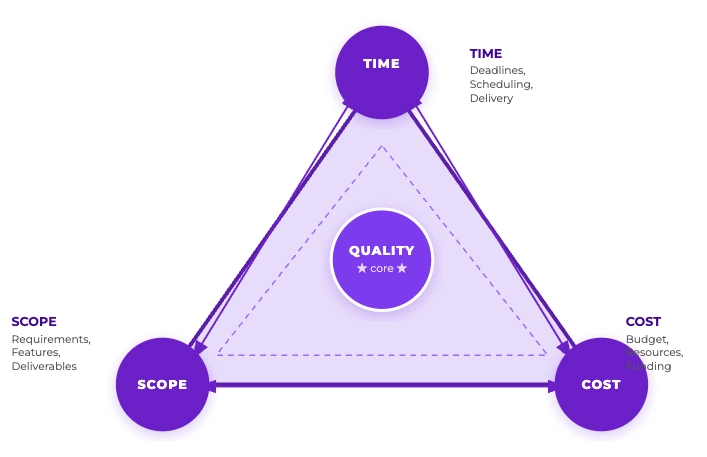
The project scope is, along with the schedule and budget, one of the three vertices of the iron triangle in project management. Defining it well is, in my experience, the skill that most distinguishes senior project managers from junior ones.
The project plan contains the overall vision of the initiative, while scope management defines precisely what will be delivered and what is explicitly outside the project. This explicit exclusion — the so-called “out of scope” — is just as important as what is included, because it prevents the notorious scope creep (uncontrolled expansion of scope).
To learn more about this critical component, I recommend reading the full article on project scope, which details how to build the scope statement and how to manage it during execution.
5. Create the Work Breakdown Structure (WBS)
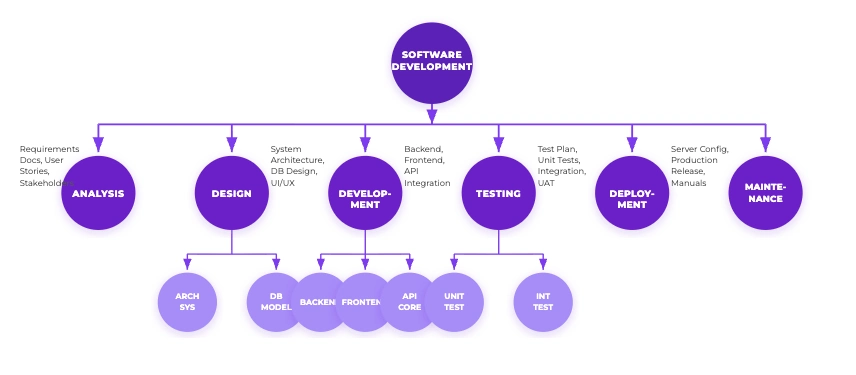
The Work Breakdown Structure (WBS) is, for me, the most valuable and underrated component of any project plan.
The WBS decomposes the project hierarchically into increasingly smaller and more manageable work packages, down to a level where each component can be estimated, assigned, and controlled independently. It is literally the complete map of the work that needs to be done.
The benefits of a well-built WBS are multiple:
- It ensures that no significant deliverable is overlooked.
- It makes it easier to estimate effort, duration, and cost with greater accuracy.
- It provides the basis for assigning owners to each work package.
- It allows for much more granular progress tracking during execution.
6. Build the Team and Assign Roles
With the WBS as a foundation, I can now determine what competencies I need and how much effort each work package requires. Now it is time to build the team and assign responsibilities explicitly.
The tool I consistently use at this stage is the RACI matrix, which defines for each task or deliverable who is:
- R — Responsible: the person who performs the work.
- A — Accountable: the person who answers to the sponsor for the result. There can be only one per task.
- C — Consulted: experts whose input is requested before the work is completed.
- I — Informed: people who must be notified of progress or results.
A well-defined RACI matrix eliminates one of the most common problems in projects: ambiguity about who makes the final call when there is a conflict of criteria.
7. Develop the Schedule and Set Milestones
The schedule is probably the most visible component of the project plan. It is what the team consults daily and what the sponsor reviews at every status meeting.
To develop it correctly, the process has several stages:
- Identify activities from the WBS work packages.
- Sequence activities by identifying dependencies between them (mandatory, discretionary, or external precedences).
- Estimate duration for each activity using techniques such as expert judgment, analogous estimating, parametric estimating, or the PERT technique.
- Develop the schedule by applying the Critical Path Method (CPM) to identify which sequence of tasks determines the minimum project duration.
- Set milestones: key checkpoints that mark the completion of phases or the delivery of critical components.
A common mistake I see repeatedly is building schedules without time buffers. A realistic plan must incorporate contingency reserves to absorb the inevitable day-to-day incidents without compromising the final deadline.
8. Define the Budget and Investment Plan
Managing the budget in a project is much more than adding up resource costs. A well-prepared budget plan distinguishes between different types of costs (direct and indirect, fixed and variable), establishes contingency reserves based on risk analysis, and defines the cost control process during execution.
The key steps to building the project budget are:
- Estimate the costs of each WBS work package (human resources, materials, equipment, subcontracting, licenses, travel, etc.).
- Aggregate costs at the deliverable and phase level to obtain the cost baseline.
- Add contingency reserves to cover the risks identified and quantified in the risk analysis.
- Add management reserves for unknown risks (the famous “unknown unknowns”).
- Define the change control process: how any significant deviation from the initial budget is approved.
What happens if the budget goes off track in month 3? Having a clear change control process in the plan prevents a small, correctable deviation from turning into a project governance crisis.
9. Conduct a Risk Analysis and Build a Contingency Plan
Risks are not alarm signals — they are information. A team that identifies and quantifies its risks early is in a position to manage them proactively. A team that ignores them will discover them as problems, and by then it will be too late to respond calmly.
The risk management process in the plan has four phases:
- Identification: use techniques such as brainstorming, historical risk checklists, the Delphi technique, or Ishikawa diagrams to identify potential threats and opportunities.
- Qualitative analysis: evaluate each risk by its probability of occurrence and impact to prioritize which ones deserve the most attention.
- Quantitative analysis: for the highest-impact risks, quantify the impact on costs and timelines using Monte Carlo simulations or decision trees.
- Response planning: define response strategies for each relevant risk (avoid, transfer, mitigate, or accept for threats; exploit, share, enhance, or accept for opportunities).
This analysis feeds directly into the budget contingency reserves and schedule buffers, thereby closing the planning cycle coherently.
10. Create the Team Communications Plan
The communications plan is the component most frequently overlooked or reduced to a simple meeting calendar. This is a mistake with serious consequences, especially in projects with multiple stakeholders or geographically distributed teams.
A good communications plan answers five fundamental questions:
- What information? Project status, risks, approved changes, performance metrics, decisions made.
- To whom? Sponsor, project team, external stakeholders, steering committee, suppliers.
- How often? Daily (Scrum stand-ups), weekly (status report), monthly (executive review), event-driven (critical risk notifications).
- Through what channel? Email, project management platform, in-person meetings, video calls, PDF reports.
- In what format? Executive dashboard, detailed status report, meeting minutes, updated risk log.
11. Establish the Baseline and Execute the Action Plan
Once all components of the plan have been defined, reviewed, and approved by the sponsor and key stakeholders, the project is ready to move into the execution phase. But first, there is a critical step that must not be skipped: establishing the baseline.
The baseline is the approved and frozen version of the plan across three dimensions: scope (scope baseline), schedule (schedule baseline), and costs (cost baseline). Together they form the performance measurement baseline, against which actual performance will be compared throughout execution.
With the baseline established, the project action plan can be set in motion. Every week, the team reports actual progress; the project manager compares that progress against the baseline; deviations are identified; corrective or preventive actions are taken; and if approved changes arise, the plan is updated and a new baseline is set. This is the control cycle that distinguishes professional project management from improvisation.
Types of Project Plans by Approach
Not all project plans are the same. The approach, time horizon, and level of detail vary significantly depending on the type of initiative and the organizational context. Here are the most relevant types.
Strategic Plan
The strategic plan operates on the broadest time horizon — typically between 3 and 5 years. Its function is to translate the organization’s vision and mission into concrete strategic objectives, priority initiatives, and projects that must be executed to achieve that vision.
As the Harvard Business Review notes on strategic planning, companies that rigorously align their projects and investments with strategy consistently outperform those that select projects reactively or out of historical inertia.
In a strategic plan, individual projects are not detailed. What is defined are the expected outcomes, the overall resources to be allocated, and the indicators that will measure progress toward the vision. The level of detail increases as we move down toward operational plans and individual project plans.
Operational and Annual Plan
The operational plan — often called the annual plan — translates long-term strategic objectives into concrete actions for the current fiscal year. It is the bridge between the strategic vision and the team’s day-to-day execution.
At this level, projects are directly tied to the year’s sales, production, operational efficiency, or customer satisfaction objectives. Resources are allocated, projects prioritized, and owners identified. The annual plan is the document the steering committee reviews quarterly to ensure the organization is on track.
Traditional Project Plan vs. Agile Project
This is one of the most frequent questions I get in project management training sessions: when should I use a predictive methodology, and when an adaptive one?
A traditional project plan (also called predictive or Waterfall) defines the complete scope up front, builds a detailed schedule, and sets a budget expected to be respected using the appropriate control tools. It works well when requirements are stable, the technology is known, and the cost of change is high. Construction, civil engineering, and ERP implementations in regulated environments are good examples.
Agile planning, by contrast, is continuous and adaptive. The initial plan is intentionally high-level: the product objective (the vision) is defined and a prioritized backlog of features is built. The detail is developed sprint by sprint, in short cycles of two to four weeks. This maximizes responsiveness to changing requirements — something especially valuable in software development, digital marketing, or product innovation projects.
In practice, most real-world projects combine elements of both approaches: a hybrid approach with predictive phases (such as architecture or integration) and agile components (such as feature development). The key is knowing how much certainty you have about your requirements and what the cost of change is in your specific context.
Common Mistakes When Creating a Project Execution Plan
I have seen the same planning mistakes made in projects across very different industries. Knowing them does not guarantee you will avoid them, but it does put you on guard.
- Failing to involve stakeholders early: gathering requirements after the fact — when something has already been built — is the fastest path to massive rework and client dissatisfaction.
- Unrealistic time estimates: teams, especially when motivated, tend to be overly optimistic. Estimates without contingency buffers produce fragile schedules that break at the first unexpected event.
- Failing to update the plan when changes occur (scope creep): accepting scope changes informally, without evaluating and approving them formally, is the most common cause of budget overruns and delays.
- Confusing the schedule with the plan: a Gantt chart is a tool, not the plan. A plan without risk management, a communications plan, or defined quality criteria is an incomplete plan.
- Not reviewing the plan during execution: a plan that is not updated becomes a useless historical document. Projects evolve; the plan must evolve with them.
- Underestimating the human factor: actual resource availability is rarely 100%. Training, vacations, sick leave, unplanned meetings, and parallel projects consume capacity that the plan must account for.
How many times have you seen a team commit to a deadline they knew was impossible? What impact did that have on the credibility of the project manager and the team?
Real-World Project Plan Example
To turn everything above from theory into something tangible, here is a real project plan example: the opening of a new commercial branch for a financial services company.
Context: a wealth management advisory firm wants to open a new office in a major city within 6 months. The authorized budget is $200,000 USD. The goal is to acquire the first 50 clients in the 3 months following opening.
Here is how the plan phases would be applied:
- Project Charter & Feasibility: the steering committee approves the opening based on a market study identifying an opportunity in the high-net-worth client segment in the northern part of the city. The charter authorizes the project with a $200,000 budget and appoints a responsible project manager.
- Stakeholders: general management (sponsor), commercial director (internal client), operations director, office renovation contractor, law firm for lease agreements, financial regulator (for notification).
- SMART Objectives: open the office — operational and regulatory compliance achieved — before November 30th, with a maximum cost of $200,000, and with CRM and compliance systems installed and tested.
- Scope: finding and leasing the office space, renovation, IT equipment, obtaining licenses, hiring 3 advisors, initial team training. Does not include the marketing campaign (a parallel project managed by the marketing team).
- WBS: four major deliverables: operational office space, IT infrastructure, hired human team, and regulatory compliance. Each broken down into specific work packages.
- Schedule: 24 weeks with milestones at week 4 (lease signed), week 10 (renovation complete), week 16 (IT infrastructure installed), week 20 (team hired and trained), week 24 (official opening).
- Budget: $130,000 for renovation and equipment, $40,000 for human resources (recruitment and training), $18,000 for software licenses, $12,000 contingency reserve.
- Key Risks: delays in obtaining business activity permits (mitigation: start the process in week 1); increase in construction costs (mitigation: fixed-price contract with renovation company); difficulty recruiting senior profiles (mitigation: launch recruitment from week 1 in parallel).
With this base plan, the project manager has everything needed to launch execution with confidence, track progress weekly, and make informed decisions in the face of any deviation.
Advance Your Career in Project Management
A well-built project plan is not a luxury for large projects or a mandatory bureaucratic exercise — it is the difference between delivering results consistently and living in a permanent state of firefighting. Planning is the most profitable activity a project manager can engage in, because every hour invested in planning is recovered many times over in time saved during execution.
If there is one thing I have learned after years working on high-complexity projects, it is that the best project managers are not those who improvise the most — they are those who plan the most, and the best. And that skill can be developed: it is learned through methodological frameworks, refined through practice, and validated through internationally recognized credentials.
If you want to understand in depth what obtaining the most recognized credential in the field entails, start by reading about what the PMP certification is and what its requirements are. It is the first step toward knowing whether you are on the right path.