
If you’ve ever felt a project slipping out of your control midway through, watched the budget spiral without really understanding why, or seen your team start pulling in different directions—you’re not alone. The truth is that most project management problems don’t stem from a lack of talent or effort. They come from a lack of clarity about project phases and how to navigate them with purpose.
In this guide, I’ll walk you through—drawing on my experience as a project management professional—what the project life cycle is, what its stages involve, how to apply them in practice, and what mistakes to avoid so your initiatives actually succeed. I’ll do it straight to the point, with real examples and the technical depth you deserve if you’re serious about mastering this field. According to the PMI Pulse of the Profession report, organizations that apply mature project management practices complete 92% more of their initiatives on time, within budget, and within scope. The numbers speak for themselves.
What Is the Project Life Cycle?
The project life cycle is the framework that defines the sequential phases every initiative goes through—from the moment it’s born as an idea to the moment it’s formally delivered and closed. It’s not a simple administrative process or a checklist to tick off: it’s the backbone on which real value creation is built for the client, the business, and all stakeholders.
Understanding the project life cycle means recognizing that each phase has specific inputs, tools, techniques, and outputs. Moving from one stage to the next isn’t arbitrary: there’s a success criterion that must be met. And skipping or compressing phases—something very tempting when deadlines are tight—is the most direct path to project failure.
Think of it this way: a project without a well-defined life cycle is like building a skyscraper without blueprints. You can make progress for a while, but sooner or later the structure starts to crack.
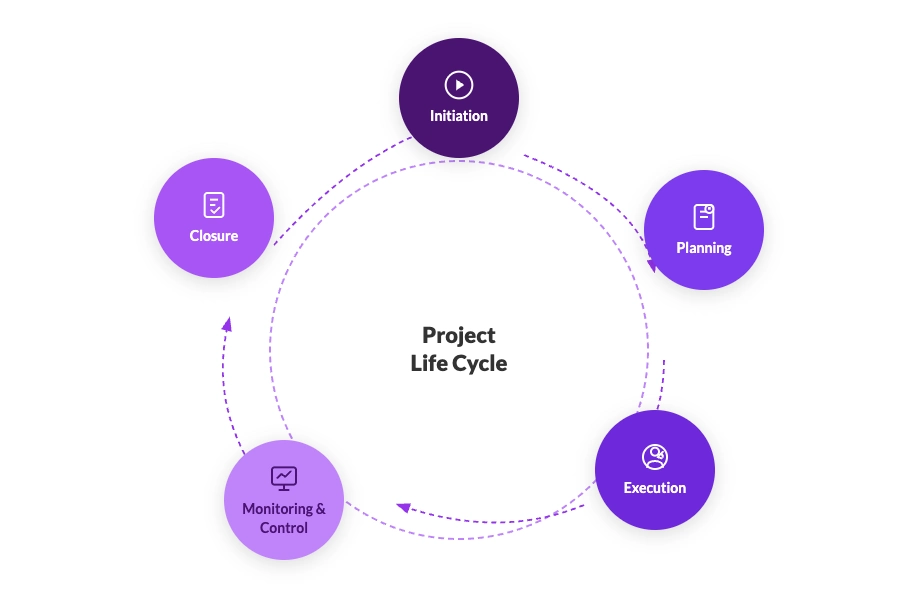
The 5 Project Management Phases
Let’s take a detailed look at each of the project management phases. I won’t give you a surface-level overview—I want you to understand what actually happens at each stage, what decisions are made, and what the key deliverables are that you need to produce before moving forward.
1. Initiation Phase: Formulation and Design Stage
Every project starts with a fundamental question: is it worth doing? The formulation and design stage is where that question gets answered rigorously. It’s not about enthusiasm—it’s about evidence.
In this phase, we develop the business case, a document that justifies the project investment in terms of cost, expected benefit, and strategic alignment with the organization. We then conduct a feasibility study to assess whether we have the technical, financial, human, and time resources needed to complete the project successfully.
If the outcome is positive, we draft the Project Charter—the document that officially brings the project to life, defines its purpose, formally authorizes the project manager, and establishes the initial constraints of time, scope, and cost.
Key deliverables for this phase:
- Validated business case
- Technical and economic feasibility study
- Project Charter
- Initial stakeholder register
2. Project Planning Phase
If the initiation phase is the embryo, planning is the project’s DNA. This is where the decisions are made that will determine the success or failure of everything that follows. The planning phase is, without a doubt, the richest in documents, tools, and analysis.
In this stage, objectives are precisely defined (using the SMART method), the Work Breakdown Structure (WBS) is built, the schedule is designed with its dependencies and milestones, and the baseline budget is developed. But perhaps the most critical element of this phase is scope management, because anything not defined in the scope doesn’t exist for the project—and anything added without control generates the dreaded scope creep.
This is also where we plan human resources management, along with communication, risk management, quality, and procurement plans. The outcome is the Project Management Plan—the master document that will guide all future decisions.
Key deliverables for this phase:
- Project Management Plan
- WBS / Work Breakdown Structure
- Project schedule with milestones
- Cost baseline and budget
- Risk management plan
3. Execution and Development Stage
This is where the rubber meets the road. The execution stage is where the team stops planning and starts building. This is where the bulk of the budget is consumed and where the project manager shifts from being a planner to being an operational leader.
The implementation stage involves coordinating people, managing conflicts, ensuring that every task is carried out according to the plan, and that the quality of the product or service aligns with the agreed-upon requirements. Stakeholder communication becomes critically important at this stage: they must be kept informed, their expectations managed, and their approvals secured at key decision points.
The development stage is also when risks either materialize or get mitigated. A well-prepared team knows that unexpected events are part of the game—not an anomaly. The difference between a successful project and a failed one often comes down to how those unexpected events are handled.
Key deliverables for this phase:
- Project deliverables (per the defined scope)
- Performance and status reports
- Updates to the Project Management Plan
- Formally managed change requests
4. Monitoring and Control Stage
This is the most underestimated phase, and paradoxically, the one that delivers the most long-term value. The monitoring stage doesn’t happen at the end—it runs in parallel with execution, continuously and systematically.
The goal of the control stage is to measure the project’s actual performance against the baseline plan and make corrective decisions before deviations become irreversible problems. We use techniques like Earned Value Management (EVM) to accurately calculate whether the project is ahead or behind schedule, and whether it’s spending more or less than budgeted.
This is also the phase where integrated change control is managed: any modification to scope, schedule, or cost must go through a formal impact analysis process before it’s approved. There are no informal changes, no hallway agreements. Everything is documented.
Key deliverables for this phase:
- Performance reports with EVM metrics
- Issue log and corrective action records
- Formally approved or rejected changes
- Updated risk register and forecasts
5. Closure and Operations Stage
Everything that has a beginning has an end—and in project management, that end must be just as rigorous as the beginning. The closure stage validates that the work is complete, that deliverables have been formally accepted by the client, and that the project can be officially closed.
But closure goes well beyond signing an acceptance form. It also includes the operations stage: the formal transition of the deliverable to the operational team that will maintain it going forward. Lessons learned are documented—one of the most valuable and most neglected assets in many organizations—team resources are released, and all project documentation is archived.
A strong closure stage turns the experience of the current project into organizational knowledge for future projects. It is, in essence, the bridge between the present and the next opportunity for improvement.
Key deliverables for this phase:
- Formal acceptance document signed by the client
- Project closure report
- Lessons learned register
- Formal release of resources and team
Project Phases by Methodology: Predictive vs. Agile
Up to this point, we’ve been discussing the classic life cycle, also known as the predictive or waterfall life cycle. This approach is built on the premise that the scope is known from the start and that each phase must be completed before the next one begins. It’s ideal for projects with high certainty, such as infrastructure construction or system implementations with fixed requirements.
However, in environments where requirements change frequently—especially in software development, digital marketing, or product innovation—the predictive life cycle can be too rigid. This is where agile methodologies come in, with frameworks like Scrum or Kanban, which propose iterative and incremental approaches.
In an agile life cycle, instead of sequential phases, we work in short sprints or iterations (typically two to four weeks), at the end of which a functional increment of the product is delivered. The planning, execution, and review phases repeat in each iteration, allowing continuous incorporation of real client feedback.
Which is better? The honest answer is: it depends. The PMI, in fact, recommends a hybrid approach—combining predictive elements (for project governance) with agile elements (for work execution). At BePM®, we train professionals in both approaches so they know how to choose the right one for each context.
Who Manages the Project Life Cycle?
The most direct answer is: the project manager. But what a project manager actually does goes far beyond a job title. The PM is the professional responsible for integrating, coordinating, and leading all project activities throughout its life cycle, ensuring that time, cost, scope, and quality objectives are met.
Their role evolves with each phase:
- During initiation: they act as an analyst and negotiator, defining the scope with the project sponsor and stakeholders.
- During planning: they act as the project architect, designing the plan that will guide the entire effort.
- During execution: they act as a team leader and resource manager, removing roadblocks and sustaining team motivation.
- During monitoring: they act as a data analyst, interpreting metrics and making corrective decisions.
- During closure: they act as a steward of organizational knowledge, documenting lessons learned for the future.
In complex or large-scale projects, the Project Manager may be supported by a PMO (Project Management Office)—an organizational structure that standardizes processes, provides methodology, and oversees the company’s project portfolio.
Real-World Example of Project Phases
Nothing teaches better than a solid real-world project phase example applied to a concrete situation. Let’s imagine a retail company wants to launch a new customer loyalty mobile app. Here’s how the 5 phases would play out:
- Initiation: The CEO initiates the project after noticing that competitors are gaining market share with their own apps. A business case is developed estimating a 35% ROI over 18 months, and the Project Charter is approved with an initial budget of $220,000.
- Planning: The team defines the app’s functional requirements (points system, push notifications, purchase history). The WBS is built with over 80 work packages, a 9-month schedule is established, and the main risks are identified: dependency on an external technology vendor and potential resistance from older users to digital adoption.
- Execution and Development: The development team—working in 3-week sprints—builds the backend, designs the user interface, and integrates with the existing CRM. The PM holds weekly status meetings and manages two critical incidents: a payment API failure and the unexpected medical leave of the lead developer.
- Monitoring and Control: At the project’s midpoint, EVM analysis reveals a CPI (Cost Performance Index) of 0.87, indicating the project is burning through more budget than planned. The PM activates a response plan: renegotiates the contract with the technology vendor and redistributes tasks across the team to recover efficiency.
- Closure and Operations: The app launches in the app stores 72 hours behind the original plan. The client formally accepts the deliverable. Key lessons about managing dependencies with external vendors are documented for similar future projects, and the team is released for their next assignments.
This complete project life cycle—with its real-world tensions and decisions—is exactly what you’ll experience in any organization that takes project management seriously.
Common Mistakes in Managing Project Stages
Field experience and data from the Standish Group Chaos Report consistently show that only a minority of projects are completed on time, within budget, and with the original scope intact. The most frequent mistakes aren’t technical—they’re process and behavioral failures. To truly master project management, you have to learn to recognize and avoid them.
- Poor scope definition in the initiation phase. When the scope isn’t clear from the start, the project sails without a compass. Each stakeholder has a different picture of the expected outcome, and those differences surface—at a very high cost—during execution.
- Underestimating the planning phase. The pressure to “just get started” leads many teams to jump straight into execution without a solid plan. The predictable result is replanning on the fly, with all the cost overruns and chaos that entails.
- Absence of change control. Accepting scope changes without a formal process is the number one cause of scope creep. Every change introduced without an impact analysis is a ticking time bomb for the schedule and budget.
- Ignoring risk management. Many teams log risks at the start of a project and then forget about them. Risk management is a continuous process that must be revisited at every status meeting.
- Skipping proper closure documentation. Closing a project without documenting lessons learned is like studying hard for an exam, passing it, and then throwing away all your notes. Knowledge is lost, and the same mistakes repeat themselves on the next project.
Every one of these mistakes has a solution, and they all follow the same path: solid training, applied methodology, and real-world practice.
Advance Your Career in Project Management
Now that you have a thorough understanding of project phases and how the project life cycle works, the natural question is: how do I turn this knowledge into a real professional advantage?
The answer is the same one that the world’s top project managers have been giving for decades: get certified. An internationally recognized credential not only proves you know what you’re talking about—it opens doors to more complex projects, larger teams, and significantly higher compensation.
At BePM®, we offer two main paths depending on your profile and experience:
- If you have verifiable project experience, the PMP certification (Project Management Professional) is the gold standard recognized in more than 190 countries.
- If you’re just starting out in project management, the CAPM certification (Certified Associate in Project Management) is the ideal entry point to demonstrate your commitment to the profession.
The time to take the next step is now. The job market rewards professionals who invest in themselves with purpose and method. And as we’ve seen throughout this guide, method in project management is everything.
Are you ready to transform your career? Explore our training programs at BePM® and find the one that best fits where you are right now.