
Have you ever watched a promising project descend into a chaos of missed deadlines, blown budgets, and frustrated teams? It happens more often than we’d like to admit. And the problem, almost always, isn’t a lack of talent or resources — it’s a lack of direction.
That’s the root of the problem. Without a clear methodology for managing work, projects become an obstacle course where every week brings a new crisis. Stress skyrockets, costs multiply, and objectives fade into the horizon.
This is where project management. project management is the discipline that turns chaos into order, deadlines into realities, and ideas into results. In this article, you’ll understand exactly what it is, what it’s for, what its phases are, what a professional in this field does day-to-day, and how you can build a career in one of the most in-demand fields of the 21st century.
What Is Project Management and What Does It Do in the Business World
The project management, is the application of knowledge, skills, tools, and techniques to project activities in order to meet project requirements. This is how the Project Management Institute (PMI®), the world’s leading reference organization in this discipline.
But if I had to explain it in my own words, I’d say that project management what it is and what it’s for boils down to one idea: taking a concept from point A to point B efficiently, in a controlled way, and with the right resources. It’s not just about managing tasks or making endless lists in a spreadsheet. It’s a strategic discipline that connects business objectives with real-world execution.
Organizations that adopt solid project management practices waste significantly less money for every dollar invested in their initiatives, as reflected in the Pulse of the Profession report from PMI®. In a business environment where every dollar counts, that data changes everything.
In short, project management exists to answer three fundamental questions: What needs to be done? Who does it? And when and with what resources?
Core Principles of Project Management
With the release of the 7th Edition of the PMBOK®, the approach to project management evolved. We no longer talk only about rigid processes but about universal principles that guide practice regardless of industry or methodology.
The four pillars every professional must internalize are:
- Value focus: every decision must be oriented toward generating real value for the business and its stakeholders, not just executing processes out of habit.
- Adaptability and resilience: projects live in constantly changing environments. The ability to pivot without losing sight of the goal is essential.
- Collaborative leadership: the modern project manager doesn’t give orders; they facilitate, motivate, and align multidisciplinary teams.
- Complexity management: identifying interdependencies, ambiguities, and risks before they turn into real problems.
These principles are the DNA of any well-managed project, and they apply just as much to a construction project as to the launch of an app or a marketing campaign.
What Does Project Management Actually Do? Roles and Responsibilities
When someone asks me what project management does, I usually answer with another question: what doesn’t it do? The project director — also known as the Project Manager or PM — is the central axis around which all project execution revolves.
Their main responsibilities include:
- Stakeholder management: identifying all interested parties, understanding their expectations, and maintaining fluid, transparent communication throughout the entire project life cycle.
- Budget control: developing realistic estimates, tracking spending, and applying corrective actions when the project deviates from the financial plan.
- Risk management: anticipating problems before they occur, evaluating their probability and impact, and designing contingency plans.
- Team coordination: assigning tasks according to each person’s competencies, resolving conflicts, and keeping motivation high even under pressure.
- Monitoring and reporting: measuring actual progress against the plan and communicating project status to organizational leadership.
If you want to dive deeper into what this professional does day-to-day, I recommend reading about what a Project Manager does and discovering the full scope of this role.
Project Management Life Cycle Phases
Every standard project — regardless of its size or industry — goes through 5 critical stages defined by the PMBOK®. Knowing them isn’t optional; it’s the first step toward managing with skill and confidence.
1. Initiation
This is the definition stage. Here you answer the fundamental question: is this project worth doing? The project charter is drafted, key stakeholders are identified, and the purpose and high-level objectives are established. If this phase fails, everything that follows is built on sand.
2. Planning
Planning is where the project is won or lost, even before it has begun. The project management plan is developed: a detailed schedule, budget, risk management plan, and definition of the project scope. A solid roadmap is the difference between executing with control or constantly putting out fires.
3. Execution
The plan is put into action. The project manager coordinates people, manages resources, and ensures that work is carried out in accordance with agreed quality standards. Communication is critical in this phase: the team needs clarity, and stakeholders need visibility.
4. Monitoring and Controlling
This phase happens in parallel with execution, not after it. KPIs are measured, deviations from the plan are detected, and corrective or preventive actions are applied. A PM who doesn’t measure doesn’t manage — they just improvise.
5. Closing
The project is formally delivered, client acceptance is obtained, and all generated learnings are documented. Lessons learned are the most valuable asset a well-closed project leaves behind: the knowledge that fuels the organization’s next projects.
Explore the Different Project Management Methodologies
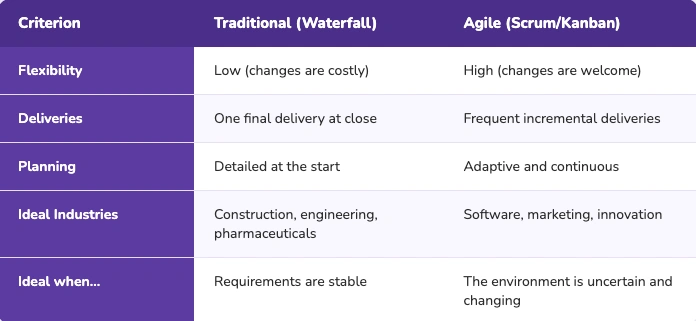
One of the most common questions I get is what project management is actually for when we talk about methodologies. The answer is simple: not all projects are the same, and using the same approach to build a building as to develop an app is a mistake that comes at a high cost.
Choosing the right methodology is a strategic decision that directly impacts efficiency, quality, and client satisfaction. Let’s look at the two main families.
Traditional Methodologies (Waterfall)
The Waterfall approach is the classic, predictive model. It’s characterized by each project phase needing to be completed before moving to the next, with requirements defined in great detail at the start.
It works especially well when:
- Requirements are clear and stable from the beginning.
- The cost of changes is very high (construction, civil engineering, manufacturing).
- Strict regulation requires exhaustive documentation.
Its great advantage is predictability. Its great weakness is rigidity in the face of change.
Agile Methodologies (Scrum and Kanban)
Agile methodologies were born as a response to a world that changes faster than any plan can anticipate. Instead of planning everything in detail from the start, they work in short delivery cycles (iterations or sprints) that allow for frequent course corrections.
Scrum is the world’s most widely used agile framework. It’s organized into 2- to 4-week sprints, with defined roles (Product Owner, Scrum Master, Development Team) and structured ceremonies. If you’re interested in specializing, the PMI-ACP certification is the reference standard for agile professionals, and the Scrum Product Owner certification is ideal for those who lead product vision.
Kanban, on the other hand, focuses on visualizing workflow and limiting work in progress (WIP), making it ideal for operations or continuous support teams.
Common Challenges in Project Management
No project is a straight line. Throughout my experience, I’ve seen the same obstacles come up again and again:
- Scope Creep: the project starts growing uncontrollably. The client requests “small” modifications that, added together, double the original workload with no additional budget. It’s the number one silent enemy of PMs.
- Poor communication: teams work in silos, messages get lost, and decisions are made with incomplete information. Poor communication is the root cause of most project conflicts.
- Lack of stakeholder support: when project sponsors don’t prioritize their decisions or fail to allocate the promised resources, the PM has their hands tied and the project stalls.
- Unrealistic estimates: promising timelines and budgets without a solid foundation is the perfect recipe for failure. Optimism is a virtue; wishful thinking is a risk.
- Resistance to change: new methodologies and improved processes are useless if the team doesn’t adopt them. Organizational change management is a critical competency that many PMs underestimate.
Recognizing these patterns early is half the battle. The other half is having the tools and the judgment to manage them.
The Project Management Office ecosystem
In large corporations, project management cannot be left to the individual discretion of each project director. That is what the PMO (Project Management Office) is for.
The PMO is the organizational unit responsible for standardize project management processes, establishing governance, defining corporate methodologies, and ensuring the strategic alignment of all organizational projects.
Its main functions include:
- Defining and maintaining project management standards, templates, and tools.
- Overseeing the portfolio of active projects and their alignment with corporate strategy.
- Providing training and mentorship to project managers.
- Consolidating performance information and reporting to senior leadership.
A well-implemented PMO multiplies the return on investment in projects and drastically reduces failures. If you want to lead or work in one, the PMO certification is the most direct path to acquiring these competencies.
The Future of Project Management: AI and Hybrid Approaches
Project management is in the midst of a transformation. Artificial Intelligence has arrived in the field not to replace the project manager, but to free them from the most routine tasks and allow them to focus on what truly matters: strategy and leadership.
Today there are already AI-powered tools capable of automatically generating schedules, drafting meeting minutes in real time, identifying risks from historical data, and predicting deviations before they occur. The PM of the future \u2014 which is already the PM of the present \u2014 needs to know how to work with these systems, not against them.
On the other hand, the pandemic irreversibly accelerated the adoption of hybrid work environments. Managing teams distributed across different time zones, cultures, and digital tools has become a core competency. Hybrid models blending predictive and agile methodologies are also gaining ground because no single approach is sufficient for today’s complexity.
The professional who combines technical mastery, adaptability and digital fluency will have a tremendous competitive advantage in the years ahead.
Why Get Trained and Certified in Project Management?
If you’re still on the fence about whether it’s worth investing in your project management training, the data speaks for itself.
The informe Talent Gap: Ten-Year Employment Trends report from PMI® estimates that by 2030, millions of new project management professionals will be needed worldwide. Demand far exceeds the supply of qualified talent, which means certified professionals are and will continue to be enormously valued in the job market.
Beyond the demand factor, the salary impact of certification is very significant. You can check how much a certified professional actually earns by consulting the project manager salary, where you’ll see that the differences compared to non-certified profiles are notable in virtually every country.
The most internationally recognized certifications are:
- PMP® (Project Management Professional): the gold standard for experienced project managers. Learn more about what it takes to earn it at the official PMP certification.
- CAPM® (Certified Associate in Project Management): the ideal entry point for those who want to start their career in project management. If that’s your case, you can take the first step and CAPM certified through the PMI.
- PMI-ACP® (Agile Certified Practitioner): the reference certification for professionals who lead projects using agile methodologies.
Getting certified isn’t just about adding a badge to your LinkedIn profile. It’s about proving that you have the knowledge, experience, and commitment to manage high-impact projects with confidence.
Conclusion
Throughout this article, we’ve covered everything you need to know to understand project management in depth: its definition and strategic purpose, the principles that govern it, the phases of a project life cycle, the roles and responsibilities of the project manager, the available methodologies, and the most common everyday challenges.
Project management is not a trend or unnecessary bureaucracy. It’s the difference between organizations that achieve their objectives systematically and those that survive by improvisation and luck.
If you’ve made it this far, you probably already know you want to go further. At PMI® we’ve spent years training project managers, agile leaders, and PMO professionals who work today at the world’s most demanding companies.
The time to become a professional is now. Explore available certification programs and take the next step in your career. Your future as a Project Manager starts here.