
If you have spent time in the world of project management or operations management, you have probably asked yourself: what is Six Sigma and why do so many top-tier companies talk about it? Let me tell you something: it is not hype. It is one of the most powerful methodologies that exist for transforming the way an organization operates.
The real problem is that most business processes coexist with a silent enemy: variability. That variability generates errors, rework, unsatisfied customers, and ultimately costs that drain directly from the profit margin. I have seen brilliant teams lose hundreds of thousands of dollars a year simply because no one had focused on improving their processes in a systematic way.
The good news is that there is a proven solution, backed by data and successfully applied in the most competitive companies in the world. That solution is called Six Sigma. Throughout this article, I will explain exactly what it is, how it works, what tools it uses, and how it can boost your career as a management professional.
What is the Six Sigma Methodology and What Are Its Origins?
The Six Sigma methodology is a structured, statistically data-driven approach whose primary goal is to reduce process variability to the point of generating fewer than 3.4 defects per million opportunities. That level of precision is equivalent to a quality rate of 99.99966% — meaning nearly perfect processes in practice.
This methodology was born in the Motorola laboratories in the 1980s, when engineer Bill Smith sought a way to drastically reduce defects in electronics manufacturing. CEO Bob Galvin mandated its widespread adoption, and the results were spectacular — savings of more than $16 billion in just over a decade — prompting companies like General Electric, Honeywell, and 3M to adopt the model and turn it into a global standard for quality management.
Today, according to the American Society for Quality (ASQ) — Six Sigma, Six Sigma is one of the most widely used quality improvement frameworks in sectors ranging from manufacturing to financial services, healthcare, and technology.
The 5 Key Principles of Six Sigma
Before getting into the implementation mechanics, it is essential to understand the philosophical pillars that support the entire framework. These five principles guide any continuous improvement project under this approach:
- Absolute customer focus. Every improvement initiative starts with a key question: What does the customer truly value? The Voice of the Customer (VOC) defines the quality criteria that any process must meet.
- Measure the value chain. You cannot improve what you do not measure. Six Sigma requires precisely quantifying the current performance of processes before intervening.
- Eliminate defects and reduce variability. The enemy is not just the occasional error, but the systematic inconsistency that makes results unpredictable.
- Involve the teams. Improvement does not happen in the boardroom. It requires the active participation of the people who operate the processes day after day.
- Culture of continuous improvement. Six Sigma is not a project with an end date. It is a permanent operating philosophy that pursues excellence on an ongoing basis.
Stages of the Six Sigma Methodology
The practical application of Six Sigma varies depending on whether the objective is to optimize an existing process or design one from scratch. Each scenario has a specific implementation model.
DMAIC Model (For Existing Processes)
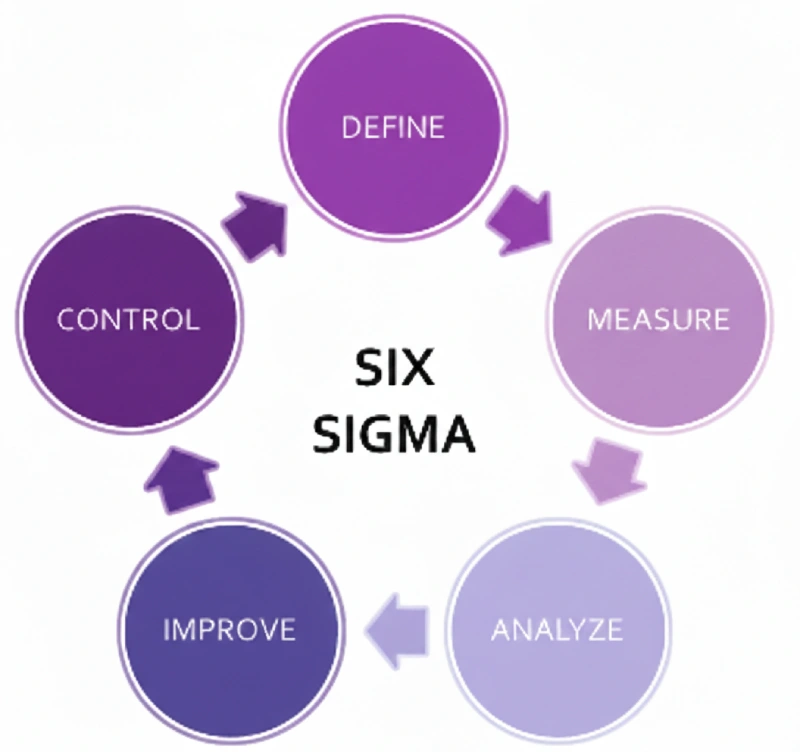
The DMAIC model is the operational core of Six Sigma for improving ongoing processes. Its five phases are:
- Define. The problem, project scope, objectives, and stakeholders are identified. It is critical to define the project scope precisely at this stage to avoid costly deviations later on.
- Measure. Quantitative data on the current performance of the process is collected. The goal is to establish a baseline against which future results can be compared.
- Analyze. With data in hand, the root causes of defects and variability are identified. Tools such as the Ishikawa Diagram and the 5 Whys come into play here.
- Improve. Solutions that eliminate the identified root causes are designed, tested, and implemented. The highest-impact actions are prioritized.
- Control. Once improvements are working, monitoring mechanisms are established to ensure the process does not revert to its previous state.
DMADV Model (For New Processes)
When the goal is not to improve but to create something new with an optimal quality level from day one, the DMADV model is used (also known as Design for Six Sigma or DFSS):
- Define. The purpose of the new process or product and the customer requirements are established.
- Measure. Customer needs and expectations are quantified with concrete metrics.
- Analyze. Different design options are evaluated based on their ability to meet the established requirements.
- Design. The selected process or product is developed in maximum detail and prototypes are tested.
- Verify. The final design is validated against all quality requirements before its definitive launch.
Tools Used in Six Sigma
One of the reasons Six Sigma generates such consistent results is the robustness of its analytical toolkit. Nothing is improvised here — every decision is based on evidence. Here are the most widely used tools from a management perspective:
- Ishikawa Diagram (Fishbone). This visual tool identifies all possible causes of a problem and groups them into categories (people, machines, methods, materials, environment). It is especially useful in the DMAIC analysis phase to avoid confusing symptoms with root causes.
- Pareto Diagram (80/20 Rule). Based on Vilfredo Pareto’s principle, this diagram helps identify the 20% of causes that generate 80% of problems. It allows improvement efforts to be concentrated where they truly have impact.
- The 5 Whys. An iterative technique as simple as it is powerful: when faced with a problem, you ask ‘why’ five consecutive times until reaching the actual root cause. Essential for avoiding surface-level solutions that do not resolve the underlying issue.
- Control Charts. These allow monitoring the behavior of a process over time, distinguishing between normal variation (inherent to the process) and warning signals that require intervention. They are the fundamental tool in the Control phase of DMAIC.
Six Sigma Belt Classifications
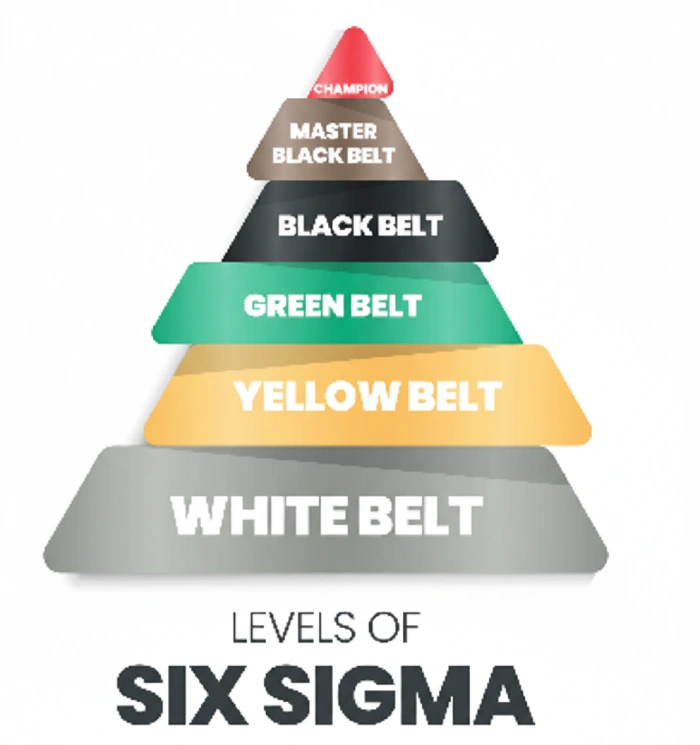
One of the most recognizable elements of the Six Sigma ecosystem is its level-based certification system, inspired by martial arts. Each Belt represents a different level of knowledge, leadership, and responsibility within improvement projects:
- White Belt & Yellow Belt. These are the entry levels. Professionals at this level understand the basic concepts of the methodology and can participate as support in projects led by more advanced practitioners. They are the ideal starting point for those new to the continuous improvement culture.
- Green Belt. A Green Belt leads improvement projects on a part-time basis, balancing this role with their regular responsibilities. They master the core analytical tools and work under the supervision of a Black Belt on more complex projects.
- Black Belt. A full-time expert. A Black Belt dedicates their entire workday to leading high-impact improvement projects, mentoring Green Belts, and acting as the technical reference for the methodology within the organization.
- Master Black Belt. The highest level in the hierarchy. Master Black Belts are quality strategists: they design the Six Sigma program at the corporate level, train Black Belts and Green Belts, and work directly with senior leadership to align continuous improvement with business objectives.
Operational Excellence: Lean Six Sigma
If Six Sigma is already powerful on its own, its combination with Lean philosophy makes it a truly transformative tool. Lean Six Sigma operational excellence emerges from uniting two complementary approaches: Lean contributes agility and the elimination of waste (wait times, overproduction, unnecessary inventory), while Six Sigma adds statistical rigor to eliminate defects and reduce variability.
The result is a hybrid methodology that works on two fronts simultaneously: it makes processes faster and more efficient (Lean) while also making them more precise and consistent (Six Sigma). This synergy is especially powerful in environments where speed and quality are equally critical.
Furthermore, this approach increasingly integrates with agile methodologies like Scrum, allowing teams to combine structured process improvement with the flexibility that today’s work environments demand. The key is knowing when to apply each tool.
Benefits of Implementing Six Sigma in Companies
The most common question I hear on this topic is: is the investment worth it? The answer is in the data. The benefits of implementing Six Sigma in companies across any sector are consistent and well-documented by institutions such as the Project Management Institute (PMI) on process improvement:
- Significant reduction in operating costs. By eliminating defects and rework, resources that were previously spent correcting errors are freed up. Companies that apply Six Sigma report savings ranging from 10% to 30% of their cost of poor quality.
- Greater customer satisfaction and loyalty. More consistent processes produce more predictable, higher-quality products and services, which translates directly into better customer experiences.
- Decision-making based on empirical data. Six Sigma eliminates ‘I think’ and replaces it with ‘the data shows.’ This reduces the impact of cognitive biases and improves the quality of strategic decisions.
- Organizational culture of continuous improvement. Beyond individual projects, implementing Six Sigma creates a profound cultural shift that encourages teams to actively seek optimization opportunities.
- Sustainable competitive advantage. As highlighted by the McKinsey study on operational excellence, organizations that embed continuous improvement into their operational DNA build competitive barriers that are difficult to replicate.
How Does Six Sigma Relate to Project Management?
This is the point I find most compelling from my perspective as a project management professional. Six Sigma does not exist in a vacuum: its implementation requires managing improvement projects with deadlines, resources, budgets, and stakeholders. In this context, the role of the project manager is absolutely central.
A Project Manager who understands Six Sigma can lead operational transformation projects with far greater impact, combining the planning, communication, and risk management skills inherent to project management with the analytical rigor of the Six Sigma methodology. The combination of both worlds is redefining what it means to be a high-performance project manager.
This integration is perfectly compatible with the most widely used international management frameworks. From the predictive approaches covered by the PMP certification to modern agile approaches, Six Sigma adds a layer of process improvement rigor that complements — rather than replaces — existing management frameworks.
A certified PM who also masters the fundamentals of Lean Six Sigma is an extremely valuable profile in today’s job market, capable of operating in both digital transformation projects and operational optimization initiatives.
Take the Next Step in Your Professional Career
Now that you know what Six Sigma is, how it works, and the value it brings to any organization, the question is: are you getting the most out of this methodology in your professional development?
If you are starting your journey in project management, the CAPM certification from PMI is the perfect starting point to solidify your foundations and stand out from day one. Your career as a high-impact project manager starts here.