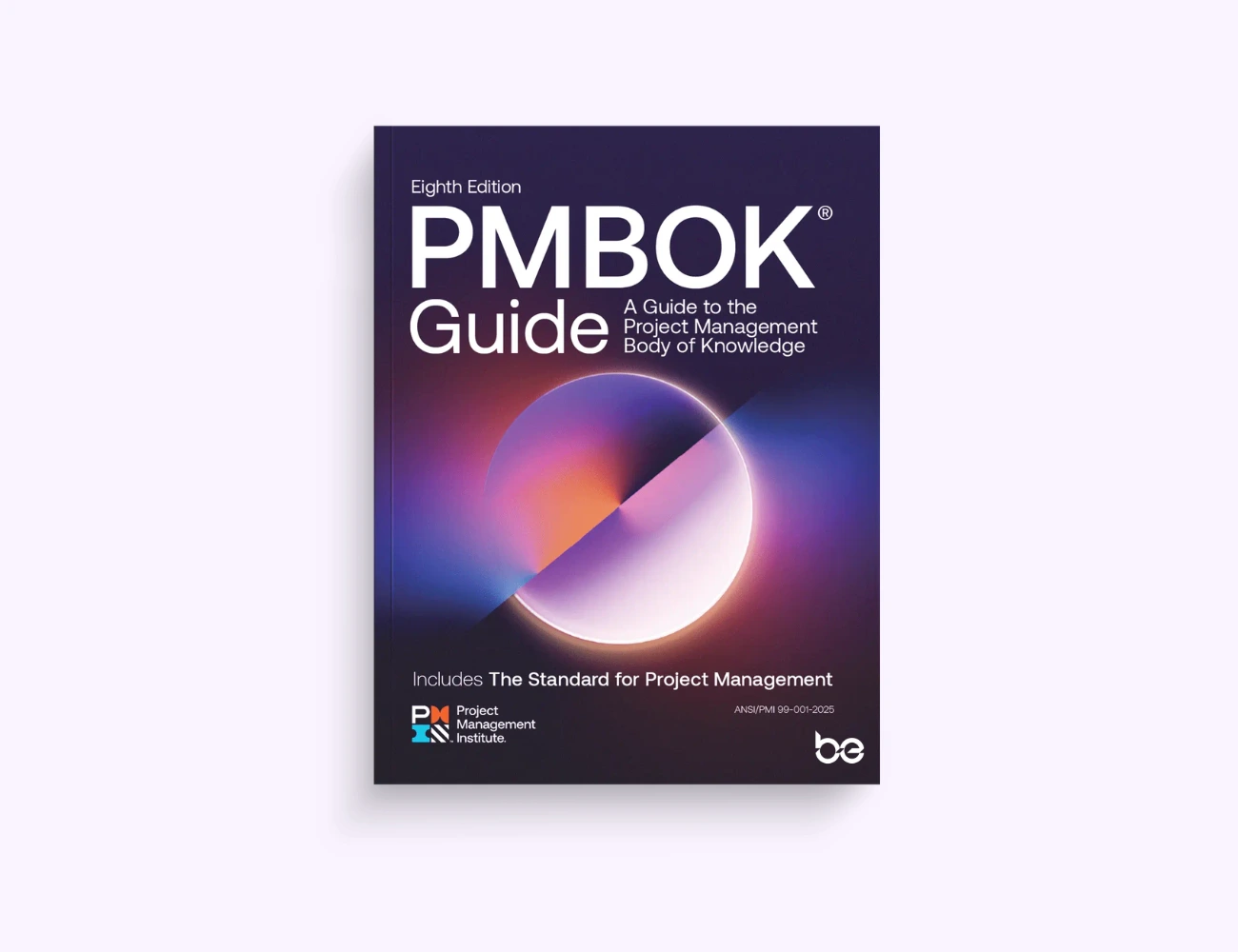

What is the PMBOK guide & its latest edition
Table of contents
The PMBOK (Project Management Body of Knowledge) is a guide published by the Project Management Institute (PMI) that compiles globally recognized best practices, standards, and processes for project management.
Its full name is A Guide to the Project Management Body of Knowledge, and its main objective is to provide a common vocabulary, a structured framework, and a set of good practices that any project management professional can apply, regardless of the sector or industry in which they work.
It is not a rigid method or a step-by-step methodology. It is, rather, a compendium of knowledge that describes what should be done in project management, without imposing a single path for doing it.
In other words: the PMBOK is the theoretical basis upon which a large part of the professional practice of project management is built internationally.
What is the PMBOK for in Project Management?
The PMBOK fulfills several fundamental functions in professional practice:
- Establishes a common language. When teams from different countries, cultures, or industries work together, they need to speak the same language. The PMBOK defines concepts, terms, and processes in a standardized way, facilitating communication and collaboration.
- Serves as a reference guide. Project managers use it to identify which knowledge areas they should manage in a project, which processes should be activated in each phase, and what inputs, tools, and outputs each of those processes involves.
- Supports decision-making. Although it does not prescribe concrete solutions, the PMBOK offers a reference map that helps professionals to better structure their projects, anticipate risks, and manage resources more efficiently.
- It is the basis for PMP certification. Practically all the content of the PMI’s PMP certification exam is based on the PMBOK Guide along with the Agile Practice Guide. Without knowing the PMBOK, passing the PMP is extremely difficult.
- Adapts to multiple contexts. From construction projects to software development, from government initiatives to technological startups, the PMBOK provides a framework flexible enough to be applied in very diverse environments.
What content is in the PMBOK?
The PMBOK Guide (in its pre-seventh editions) was structured around two major axes: process groups and knowledge areas. Although the seventh edition has introduced an approach based on principles and performance domains, the classic content remains fundamental to understanding the PMP exam.
The Five Process Groups
The process groups describe the logical phases through which a project advances. They are not phases of a life cycle in the strict sense, but rather groupings of processes that occur iteratively and sometimes overlap throughout the project.
- Initiating Process Group — Processes that define a new project or a new phase, formally authorizing its start. Here, the project charter is developed and key stakeholders are identified.
- Planning Process Group — The most extensive group in the PMBOK. It includes all processes necessary to establish the project scope, develop the schedule, define the budget, plan quality, resources, communications, risks, procurement, and stakeholder engagement.
- Executing Process Group — Processes aimed at completing the work defined in the project management plan. This is where the actual work is carried out: teams are directed, procurements are managed, and progress is communicated.
- Monitoring and Controlling Process Group — Processes that allow tracking, reviewing, and regulating the progress and performance of the project. This group acts continuously throughout the entire life cycle, identifying deviations and proposing corrective actions.
- Closing Process Group — Processes that formally finalize the project or a phase, obtaining client acceptance, archiving information, and closing contracts and resources.
Knowledge Areas
The knowledge areas represent the thematic domains that a project manager must master. In the sixth edition, the PMBOK identifies ten knowledge areas:
- Project Integration Management — Coordinates all elements of the project, ensuring that the different processes and activities are aligned with each other. It is the most transversal area of all.
- Project Scope Management — Defines what is in and what is out of the project. It includes collecting requirements, creating the WBS (Work Breakdown Structure), and controlling scope changes.
- Project Schedule Management — Covers everything related to time: defining activities, sequencing them, estimating durations, and developing a realistic and controllable schedule.
- Project Cost Management — Manages the project budget: cost estimation, budget determination, and spending control during execution.
- Project Quality Management — Ensures that the project complies with defined quality standards, both in the management process and in the final deliverables.
- Project Resource Management — Plans, acquires, manages, and releases project resources, both human and physical (equipment, materials, facilities).
- Project Communications Management — Deals with planning, managing, and controlling the flow of information among all project stakeholders in a timely and appropriate manner.
- Project Risk Management — Identifies, analyzes, and plans responses to project risks, both positive (opportunities) and negative (threats).
- Project Procurement Management — Manages the acquisition of products, services, or results needed from outside the project team: contracts, suppliers, and procurement closure.
- Project Stakeholder Management: Identifies all individuals or organizations that can affect or be affected by the project, and proactively manages their participation and influence.
What is the latest edition of the PMBOK?
The most recent edition is the Seventh Edition of the PMBOK, published by the PMI in August 2021. It represents the most radical change in the guide’s history: it abandons the process-centric focus of previous editions and adopts a model based on 12 project management principles and 8 project performance domains.
This shift reflects the growing adoption of agile and hybrid methodologies in the sector, recognizing that project management can no longer be reduced to a rigid set of processes, but must adapt to the context and nature of each project.
The seventh edition is published in the PMIstandards+ digital environment, which allows access to both the new content and the information from the sixth edition, which is still valid as a reference for the PMP exam.
Important note: PMI has confirmed the update to the eighth edition of the PMBOK (PMBOK 8) planned for 2026, which will continue the evolution of the standard to adapt to changes in professional practice and the project management ecosystem.
A bit of history: how many editions have there been?
The PMBOK has evolved considerably since its first publication, adapting to changes in the professional environment and the new realities of project management:
- 1987 — PMI publishes the first document that would give rise to the PMBOK as a framework for ethics, standards, and accreditation. It is not a formal “edition,” but it is the starting point.
- 1996 — First official edition of the PMBOK Guide.
- 2000 — Second edition, with structural improvements and greater depth in the processes.
- 2004 — Third edition, which consolidated the model of the five process groups and nine knowledge areas.
- 2008 — Fourth edition, with simplification in nomenclature and reduction of processes.
- 2013 — Fifth edition, which added Stakeholder Management as the tenth knowledge area.
- 2017 — Sixth edition, with a chapter dedicated to the role of the project manager and greater presence of agile considerations. It is still very relevant for the PMP exam.
- 2021 — Seventh edition, with the paradigm shift toward principles and performance domains.
Each edition has responded to market needs, incorporating new approaches and adapting to the reality of modern projects.
What is the best way to read the PMBOK Guide?
Reading the PMBOK from start to finish as if it were a novel is, probably, the worst possible strategy. It is a dense and very extensive technical document. These are the approaches that work best:
- First, build the general context. Before delving into the specific processes, understand the global structure: what the process groups are, what the knowledge areas are, and how they relate to each other. This will give you the map before exploring the territory.
- Read by knowledge area, not by page order. It is much more effective to study a complete area (for example, Risk Management) before jumping to the next than to read chapter by chapter in sequential order.
- Use the PMBOK as a reference, not a textbook. The guide is designed to be consulted, not memorized. Complement your reading with courses, exam simulations, and specific study materials for the PMP.
- Combine it with the Agile Practice Guide. Since the sixth edition, PMI has published both documents as a unit. For the current PMP exam, understanding the agile and hybrid approach is as important as mastering the predictive processes of the PMBOK.
- Practice with real cases. Every time you read a process or a tool, ask yourself how you would apply it in a real project. This helps to anchor the learning and better prepare you for the situational questions on the PMP exam.
PMBOK and PMP Certification: What is the relationship?
The PMP (Project Management Professional) certification is the most recognized project management credential in the world, and the PMBOK is its main reference of knowledge.
When the PMI designs the PMP exam, it starts with the Examination Content Outline (ECO), which is the document that defines the topics, tasks, and percentages of questions on the exam. This content is directly based on the principles, processes, and good practices of the PMBOK, along with the Agile Practice Guide.
The current PMP exam (since the 2021 redesign) has a predominantly situational format: it doesn’t ask you what the PMBOK says, but how you would apply its principles in real-life situations. This makes studying the PMBOK in depth—and not just memorizing it—fundamental for passing.
If your goal is to pass the PMP on your first attempt and truly understand how to apply the PMBOK to situational questions, you need structured and strategic preparation. In our PMP preparation course, we cover exactly what the current exam requires: mastery of the PMBOK framework, an agile and hybrid approach, and intensive practice with real mock exams.
Enroll now in our PMP course and start preparing with a clear, results-oriented method aligned with the official exam format.
Is using the PMBOK mandatory for managing projects?
No. The PMBOK is neither a mandatory standard nor a prescriptive methodology. It is a guide to good practices that each organization can adopt, adapt, or ignore according to its needs.
In practice, many organizations use more specific frameworks such as PRINCE2, Scrum, SAFe, or their own methodologies, without explicit reference to the PMBOK. However, in most cases, these frameworks share principles and concepts that have their origin or parallel in the PMBOK.
What is certain is that, in environments where project management certifications are valued or where projects have a significant level of complexity, the PMBOK is usually the starting point for structuring the way work is done.
Advantages of the PMBOK Methodology
The PMBOK offers a common vocabulary that greatly facilitates communication among multidisciplinary and international teams. It provides a structured and complete framework that covers all dimensions of a project, from scope to procurement. Furthermore, it is backed by the PMI, an organization with decades of research and practice in the sector, which gives it global credibility and recognition. Its application can be improved and adapted over time thanks to its successive revisions.
You should also know its limitations
The PMBOK, especially in its classic versions, can be excessively complex for small projects or agile teams. Being so broad, it can generate unnecessary bureaucracy if applied literally in contexts that do not require it. Furthermore, although the seventh edition has incorporated the agile approach, previous editions were clearly oriented toward predictive and waterfall projects. Finally, learning to apply it well requires time, training, and experience: simply reading the guide is not enough.
Is it worth getting certified based on the PMBOK methodology?
The short answer is yes, especially if your goal is to obtain PMP certification or work in environments where project management plays a strategic role.
Beyond the certification value, studying the PMBOK allows you to develop a structured and holistic vision of project management. You will learn to anticipate problems, manage change, communicate better with stakeholders, and make more informed decisions in each phase of the project.
However, you have to be realistic: the PMBOK is not an instruction manual that is going to tell you exactly what to do in every situation. It is a reference framework that, well internalized, gives you the resources to think better and manage projects with greater efficiency.
If you are starting out in the world of project management, the PMBOK can be overwhelming at first. In that case, the most advisable thing is to start with more accessible resources that explain its key concepts progressively, and go deeper as you gain practical experience.
If you already have experience and want to take the leap to PMP certification, then studying the PMBOK in depth is, quite simply, essential.

Written by Priscilla Medina
Project Manager certified by the Project Management Institute (PMI) as PMP®, ACP®, RMP®, and PBA®, Scrum Master, Agile Coach, and Agile Leader, among other agile certifications. She has more than seven years of experience leading projects in international corporate environments, applying predictive, agile, and hybrid methodologies in real high-impact projects for large accounts. As a good PM, she also organizes her busy schedule to serve as Vice President of PMI Levante (PMI Spain).

About us
We are an international academy founded in Switzerland that trains and supports professionals from around the world and at all levels in their development in Project Management.
Follow us on social media!
Subscribe to the newsletter
Receive practical advice, discounts for your exam, valuable information, and the latest news and key resources in Project Management.
Join our PM community!