
As a project manager with years of experience under my belt, I’ve learned that one of the most recurring questions in the industry isn’t technical — it’s methodological. What framework did you use to manage this project? Which approach gives me more control? When should I go predictive, and when should I embrace agility? If you’ve ever asked yourself these questions — and I know you have, because I certainly have — you’re in the right place.
Today I want to talk to you about the Waterfall methodology: the sequential model that for decades has been the cornerstone of traditional project management and that, when properly applied, remains one of the most powerful tools available. Because understanding it deeply isn’t optional — it’s a professional obligation.
What Is the Waterfall Method or Cascading Model?
The Waterfall method, also known as the cascading model, is a project management methodology that is predictive, sequential, and linear in nature. Its logic is as clear as it is powerful: no phase begins until the previous one has been completed and formally approved. Just as water falling from a waterfall cannot flow back upward, work in this model always moves forward.
This philosophy contrasts sharply with iterative approaches. In Waterfall, there is no concept of “trying and adjusting on the fly.” The project is thoroughly planned at the outset, executed according to that plan, and delivered at the end. This structure may sound rigid — and in certain contexts it is — but for projects with well-defined and stable requirements, it is precisely the discipline needed.
The model has its roots in software engineering from the 1970s, and its influence has extended into fields such as civil construction, manufacturing, and aerospace engineering. Reference bodies like the Project Management Institute (PMI) standards recognize predictive approaches like Waterfall within the foundational frameworks of project management.
Key Characteristics of the Waterfall Methodology
One of the things I appreciate most about working with the cascading model is that, when applied correctly, the entire team knows exactly where they stand and what is expected of them. Here are its defining characteristics:
- Comprehensive upfront documentation. Before writing a single line of code or laying the first brick, everything is documented: requirements, specifications, blueprints, acceptance criteria. Documentation isn’t bureaucracy — it’s the roadmap that guides the entire journey.
- Clearly defined phases. Each stage has a defined start, end, and concrete deliverables. There is no overlap or ambiguity.
- Rigidly defined roles. Each team member knows their function at every phase. This specialization raises execution quality.
- Fixed scope. Once the client approves the project scope, changes become extremely costly. This enforces a discipline of upfront analysis that eliminates unpleasant surprises.
- Strong budget control. Because all requirements and phases are known in advance, cost estimation is far more accurate than in iterative methodologies.
- Clear progress metrics. Progress is measured by completed phases, not subjective percentages. Either the phase is approved or it isn’t.
According to the Standish Group reports on project success, one of the leading causes of project failure is poorly defined scope. Waterfall attacks that problem at its root, forcing clarity from day one.
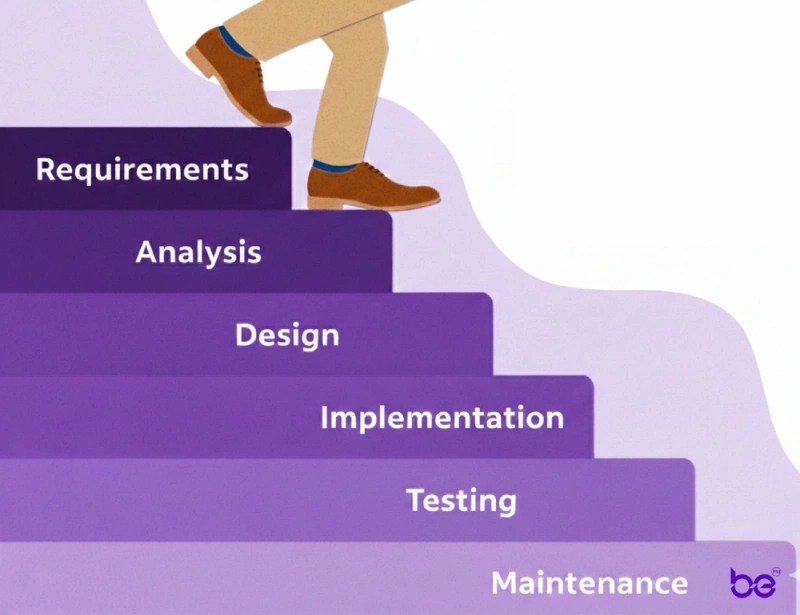
The 6 Steps of the Waterfall Methodology: The Process in Detail
When I talk about the phases of the Waterfall methodology, I like to emphasize that its sequentiality is not a limitation — it’s its greatest virtue. This logical and orderly process is precisely what makes it so effective in environments with low uncertainty and where the cost of late errors is critical.
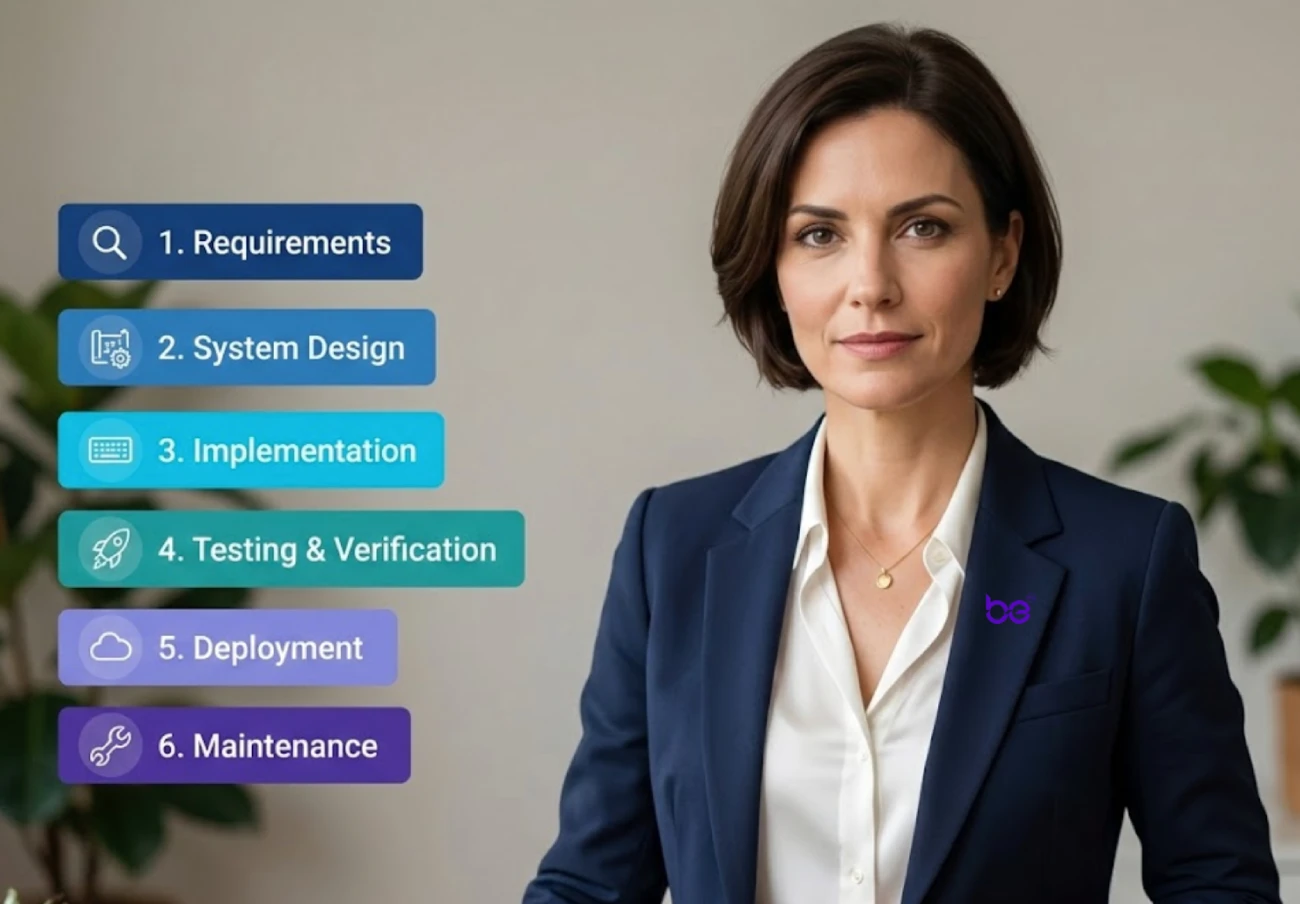
1. Requirements Phase (Gathering and Analysis)
This is, without a doubt, the most critical phase of the entire process. Here, the project team collects, documents, and validates all client needs before touching anything else. A requirement captured incorrectly at this stage becomes an exponentially larger problem in later phases.
The output of this step is a requirements specification document that the client must formally approve. Learning to define the project scope with surgical precision in this phase is what separates ordinary project managers from extraordinary ones.
2. System Design Phase
With requirements approved, the team creates the project architecture. In software, this means database design, API definitions, and application structure. In construction, it means blueprints and structural calculations. The design is the blueprint that will guide all subsequent execution.
3. Implementation and Development Phase
At this stage, the team executes and builds. It’s the most visible phase of the project, but if the two preceding phases were done well, it should also be the smoothest. Developers write code, builders construct, engineers manufacture — always strictly following the approved design. Any deviation must be channeled through a formal change control process.
4. Testing and Verification Phase
Once the product is built, the quality team verifies that everything delivered meets exactly the requirements defined in Phase 1. In software projects, this includes unit, integration, performance, and user acceptance testing.
5. Deployment Phase (Launch)
The product, once validated and approved, is delivered to the client or launched to market. In software, this means going live in production. In construction, it means handing over the keys. In Waterfall, when you reach this point with the process properly followed, the delivery tends to be remarkably clean.
6. Maintenance Phase
No project exists in isolation from the real world. The maintenance phase covers post-delivery support: fixing minor bugs not detected during testing, configuration adjustments, and small improvements agreed upon with the client. This phase can extend for years in large projects.
When to Use the Waterfall Methodology (Practical Examples)
Throughout my career, I’ve seen projects managed brilliantly with Waterfall — and projects where applying it was a strategic mistake. The key is knowing how to read the context. These are the scenarios where the cascading model truly shines:
Construction and civil infrastructure: Building a bridge, a building, or a highway is the quintessential example of a Waterfall project. Requirements are defined before the first stone is laid, and changing them mid-construction has an astronomical cost.
Industrial manufacturing and automotive: Designing and manufacturing an engine component, a household appliance, or a vehicle requires each phase to be completed and validated before moving to the next.
Hardware development and embedded systems: Unlike software, hardware can’t simply be “patched.” Once a chip or printed circuit board is manufactured, changes are prohibitively expensive.
Regulated or compliance-driven projects: Pharmaceutical, aerospace, or defense projects — where exhaustive documentation and traceability are legally mandatory — find their natural methodology in Waterfall.
Software with immutable requirements: Legacy system migrations, integrations with external platforms, or industrial control system development are cases where Waterfall remains the right choice.
Advantages and Disadvantages of Waterfall Projects
I’ll be direct: Waterfall isn’t perfect. No methodology is. But its strengths are genuine, and its well-known weaknesses are perfectly manageable when anticipated.
Advantages
Aspect | Benefit |
Budget control | The scope defined at the outset allows for precise estimates and minimizes overruns. |
Role and responsibility clarity | Each team member knows exactly what they do and when. |
Complete documentation | Facilitates knowledge transfer, maintenance, and auditing. |
Reliable timeline planning | Deadlines are predictable when requirements are stable. |
Ideal for rigid dependencies | Sequentiality ensures each block is built on a solid foundation. |
Disadvantages
Aspect | Risk |
Rigidity in the face of change | Incorporating changes in advanced phases is extremely costly. |
Late client visibility | There are no intermediate deliverables until very advanced phases. |
Assumes perfect requirements | If the initial analysis fails, the entire project can derail. |
Low tolerance for uncertainty | In volatile markets, predictability can be an illusion. |
Delayed feedback | Usability issues are only detected at the end. |
Waterfall vs. Agile Methodology
This is the comparison I’m asked about most, and I believe the “Waterfall vs. Agile” debate is framed incorrectly. They’re not competing methodologies at war with each other — they’re tools designed for different contexts. As a project manager, your job is to master both and know which to apply.
The Agile methodology emerged precisely as a response to Waterfall’s limitations in high-uncertainty environments. Where Waterfall plans everything upfront, Agile accepts that requirements will evolve and designs an iterative process to adapt. Where Waterfall delivers at the end, Agile delivers in short cycles (sprints) that allow continuous client feedback.
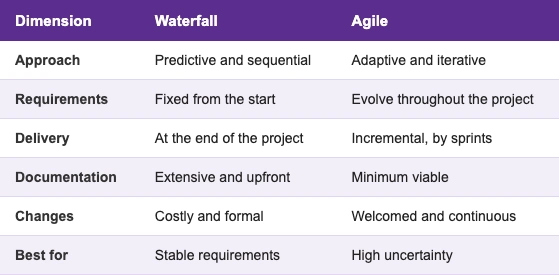
If you’re managing the development of an air traffic control system, go with Waterfall. If you’re developing a digital startup whose product will evolve with the market, go with Agile.
Master Project Management Methodologies
You’ve been reading this article about Waterfall. That tells me something: you take your professional development seriously. And that is precisely what separates project managers who simply execute from those who lead.
Understanding the cascading model is essential, but today’s market demands much more. The role of the project manager has evolved enormously in recent years, and the most sought-after professionals are those who can move comfortably across any methodology.
At BePM, you will find training designed specifically for this purpose: from programs to master project management with every guarantee to itineraries geared toward preparing for PMP certification, the most internationally recognized credential in the field of project management.
Your next professional level starts with a decision. Are you ready to make it?