
Have you ever seen a well-planned project with sufficient resources and a capable team that still failed? I have. And in most cases, the root cause wasn’t the budget or the methodology: it was poor stakeholder management. The people, groups, and entities surrounding any initiative have the power to drive it forward or sink it entirely. When we ignore them, they eventually make us pay for it.
Disruption often hits mid-project: a department head nobody consulted shows up, a supplier who wasn’t aligned with the project’s goals creates friction, or a regulatory requirement nobody accounted for suddenly surfaces. The fallout is immediate deadlines slip, budgets balloon, and team morale collapses.
This article is the definitive guide. Here you’ll find everything you need to know about stakeholders. Let’s get started.
What are stakeholders?
The stakeholders of an organization are any individual, group, or entity that can affect or be affected by the decisions, activities, and outcomes of that company or project. In other words, we’re not just talking about those who provide the funding we’re talking about everyone who has something at stake.
The term stakeholder translates into Spanish as “parte interesada” (interested party) or “grupo de interés” (interest group). In today’s business environment, ignoring any of them is a strategic mistake that can prove very costly. From front-line employees to the local communities where the company operates, everyone is part of the ecosystem of relationships that defines the success or failure of any organization.
The Origin: R. Edward Freeman’s Stakeholder Theory
The modern concept of the stakeholder was formalized by philosopher and academic R. Edward Freeman in 1984 in his seminal work Strategic Management: A Stakeholder Approach. Freeman argued that companies are not only responsible to their shareholders, but to all the groups that interact with them. This idea revolutionized business management and remains the cornerstone of contemporary strategic leadership.
What I find brilliant about Freeman’s theory is its pragmatism: it’s not just about being ethical (though that matters too) it’s that considering all interested parties is, quite simply, better business in the long run.
Stakeholders vs. Shareholders: Key Differences
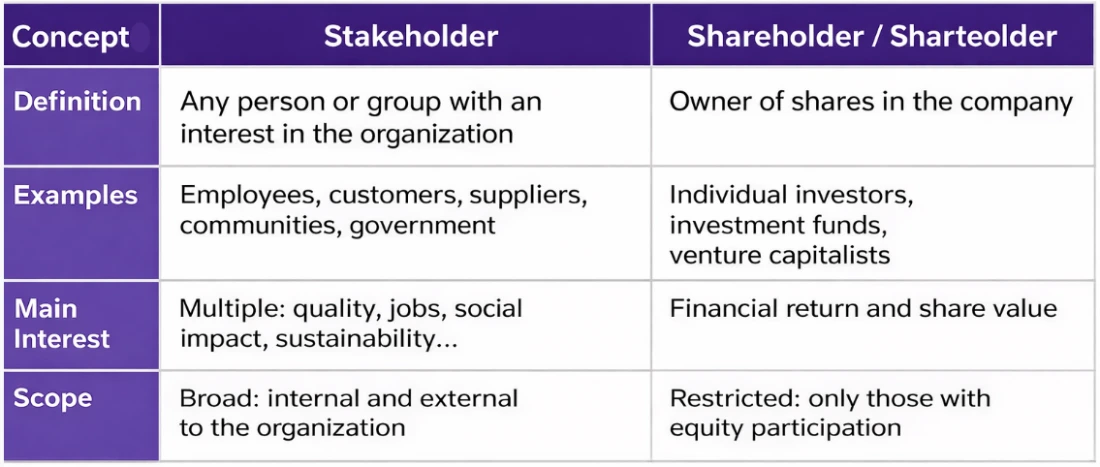
This is the most common source of confusion I see among professionals who are new to these concepts. A shareholder is a specific figure: someone who owns shares in a company and whose primary interest is financial return. A stakeholder, on the other hand, is a much broader concept that encompasses all actors in the business environment, whether or not they hold any financial stake.
Here’s a quick visual summary:
Types of Stakeholders
There are several ways to classify interested parties. The two most commonly used in Project Management and business strategy are classification by position (internal vs. external) and by level of influence (primary vs. secondary).
Internal and External Stakeholders
The first major distinction I always make in any project is separating internal and external stakeholders. This is the starting point for any stakeholder map.
Internal stakeholders (part of the organization):
- Employees and work teams
- Senior management and the board of directors
- Shareholders and partners
- Department heads
External stakeholders (outside the organizational structure):
- Customers and end consumers
- Suppliers and strategic partners
- Government agencies and regulators
- Media and public opinion
- Local communities and civil society
- NGOs and environmental groups
In my experience, the costliest mistakes happen precisely when teams focus exclusively on internal stakeholders and forget that the external environment can block or accelerate any initiative.
Primary and Secondary Stakeholders
Beyond position, I also classify interest groups by their level of direct impact on the organization:
- Primary stakeholders: they are vital to the survival of the business. Without them, the company cannot function. They include customers, employees, investors, and key suppliers. Managing them is non-negotiable.
- Secondary stakeholders: they influence the organization indirectly, but their impact can be significant if ignored. This category includes media outlets, labor unions, advocacy groups, competitors, and academic communities.
The distinction between primary and secondary is not static. A regulator may be secondary for years and suddenly become primary overnight if they introduce new legislation affecting your industry. That’s why stakeholder analysis must be ongoing, not a one-time exercise.
Real-World Stakeholder Examples
Theory is useful, but real-world examples are what truly help internalize the concept. Let me illustrate with two scenarios I’ve experienced firsthand.
Stakeholders in a Traditional Company
Imagine a mid-sized manufacturing company that produces electronic components. Its stakeholder ecosystem would look something like this:
- Internal: Production engineers who optimize processes, the finance department controlling margins, the CEO defining strategy, and shareholders demanding quarterly returns.
- External: Raw material suppliers (whose delivery delays can paralyze the entire supply chain), industrial clients purchasing the components, the IRS demanding tax compliance, the local city council regulating plant emissions, and neighboring residents monitoring environmental impact.
In this real-world case, ignoring the residents and local government resulted in a reputational crisis that halted the plant’s expansion for two years. This type of stakeholder example is far more common than it might seem.
Stakeholders in a Project
Let’s put on our Project Management hat. Suppose a mobile application development project for the healthcare sector. Even before defining the project scope, I need to identify all interested parties:
- Project Sponsor: The CEO who funds the initiative and expects a clear ROI.
- Development Team: Programmers, UX designers, and QA testers. Their concerns are technical and deadline-driven.
- End Users: Doctors and nurses who will use the app daily. Their adoption determines the product’s real success.
- Legal and Compliance Department: Verifies that the app complies with HIPAA regulations and healthcare standards.
- Technology Vendors: Cloud hosting providers, messaging services, and medical data APIs.
- Healthcare Sector Regulators: Can approve or block the product’s rollout.
In this project stakeholder example, excluding the legal department until the testing phase required a complete overhaul of the data architecture resulting in a 35% cost overrun and a four-month delay. The lesson is clear: identify your stakeholders before writing a single line of code or breaking ground.
Why Identifying Stakeholders Matters and Their Impact on the Organization
The modern project manager’s role is not just about managing tasks and deadlines it’s about managing relationships, expectations, and power. That’s where early identification of interest groups makes the difference between success and failure.
According to the PMI Pulse of the Profession, one of the most recurring factors in failed projects is precisely the lack of commitment and involvement of key stakeholders. It’s not a methodology problem, it’s a people problem. The PMI documents this year after year with hard data: ignoring interested parties is the fast track to failure.
Properly identifying and managing stakeholders allows you to:
- Align expectations from the start: Avoid unpleasant surprises in the advanced phases of a project.
- Secure necessary resources: Informed, committed sponsors release budget and political support.
- Anticipate resistance: Knowing who can block your initiative lets you proactively neutralize that resistance.
- Build corporate reputation: Organizations that manage their stakeholders well generate greater trust and long-term sustainability.
Ultimately, stakeholder management is not a bureaucratic checkbox in the project plan, it’s a real competitive advantage.
Steps for Stakeholder Management in Organizations and Projects
Over the years I’ve developed a four-step process I apply to all my projects, regardless of whether I’m working with agile or predictive methodologies. If you’re preparing for the Scrum Product Owner certification, this process will be especially useful because stakeholder management cuts across any framework.
1. Stakeholder Identification
Run an exhaustive brainstorming session with your team. Who can affect the project? Who will be affected by its outcomes? Include even those who initially seem barely relevant, better to have them mapped and not need them than to need them and not have them accounted for.
2. Power and Interest Analysis
Not all stakeholders deserve the same level of attention. Analysis helps you prioritize communication and management resources based on the real impact of each group.
3. Communication and Engagement Planning
Define what information each stakeholder will receive, how often, through which channel, and who is responsible for maintaining that relationship. A poorly designed communication plan breeds misinformation and distrust.
4. Ongoing Monitoring and Adjustment
The stakeholder map evolves. A secondary stakeholder can become critical overnight. Review the map regularly, especially at key project milestones.
Stakeholder Analysis Tools
The two tools I use most often and recommend in any advanced training are:
Power vs. Interest Matrix (Mendelow)
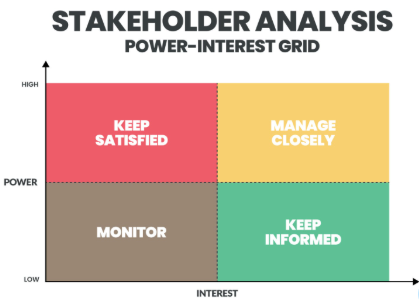
Divides stakeholders into four quadrants based on their level of power and interest in the project:
- Manage closely (high power, high interest): These are the critical stakeholders. Work with them continuously and closely.
- Keep satisfied (high power, low interest): Communicate regularly, but don’t overwhelm them with information.
- Keep informed (low power, high interest): Share frequent updates. Their enthusiasm can be a valuable asset.
- Monitor (low power, low interest): Check in periodically, but don’t invest excessive resources in them.
RACI Matrix
Complements the Mendelow analysis by defining each stakeholder’s role for every task or deliverable in the project: Responsible, Accountable, Consulted, Informed. It’s an indispensable tool for eliminating ambiguity and responsibility conflicts.
Combining both matrices gives you a complete map: you know who holds power and who does what. That’s high-level stakeholder management.
The Impact on Corporate Social Responsibility (CSR)
Stakeholder management and corporate social responsibility (CSR) are inherently linked. In fact, you cannot build a coherent CSR strategy without a clear map of all interested parties. When an organization involves its stakeholder groups in defining its sustainability policies, it creates a dual impact: internally, it improves corporate culture and talent retention; externally, it builds reputation and generates trust in the business, social, and environmental spheres.
In this area, global standards serve as the essential reference point. The OECD Guidelines for Multinational Enterprises establish clear frameworks for organizations to manage their relationships with all stakeholders in a responsible manner covering labor practices, environmental conduct, human rights, and governance.
In practice, companies that integrate the voice of their stakeholders into their CSR strategies achieve measurable results: higher employee satisfaction, reduced conflict with local communities, better access to green financing, and a stronger standing before regulators. This isn’t philanthropy it’s smart strategic management.
The Key to Success in Managing Your Projects
If there’s one thing my experience in project and organizational management has taught me, it’s that stakeholders are not an administrative detail of the project plan they are the core of every successful initiative. Identifying, analyzing, engaging, and monitoring them is not optional; it’s the difference between a project that delivers real value and one that falls short.
From the smallest startup to the largest multinational, from a tech project to a construction site, stakeholders are always present. The question isn’t whether they’ll influence your project it’s whether you’ll be ready to manage them when they do.
If you want to take this competency to the next level and earn internationally recognized credentials, I recommend exploring the PMP certification the gold standard in project management worldwide. Stakeholder management isn’t just a technical skill: it’s an art that is refined through practice and proper training. Start today.