Tuckman’s stages of group development
Table of contents
Every project manager has experienced it: a newly assembled team that starts with enthusiasm but quickly hits turbulence, miscommunication, and competing priorities. Understanding why this happens and what to do about it is one of the most valuable competencies in modern project management. Bruce Tuckman’s model of group development gives managers a proven framework to diagnose where their team stands and apply the right leadership strategy at the right moment.
Team maturity is the single most determinative factor in project outcomes. A technically brilliant team stuck in perpetual conflict will consistently underperform a moderately skilled team that has mastered how to work together. Tuckman’s model is the foundational tool for assessing that maturity and it’s directly tested in both the PMP® and CAPM® certification exams.
What Are the 5 Stages of Team Development?
Tuckman’s model identifies five sequential stages that virtually every team moves through on its path to high performance. While the speed of progression varies, the sequence is consistent across industries, cultures, and project types.
- Forming: Orientation and initial acquaintance. Team members are positive but uncertain about their roles and the project’s direction.
- Storming: Emergence of conflict and competition. Differences in working styles, expectations, and authority create friction.
- Norming: Establishment of shared norms and cohesion. The team resolves conflicts and builds mutual respect.
- Performing: High performance and autonomy. The team delivers results without managerial friction.
- Adjourning: Dissolution of the team and capture of lessons learned. A deliberate close to the project lifecycle.
Quick Insight: Not every team progresses smoothly through these stages. Teams can regress for example, moving from Norming back to Storming when key members leave or project scope changes significantly. Recognizing these triggers is a core skill for senior project managers.
Historical Context: From 4 Stages to 5
To fully understand Tuckman’s model, it’s essential to appreciate its academic evolution a distinction that separates authoritative project management resources from superficial blog posts.
1965: The Original Four-Stage Model
Bruce W. Tuckman published his landmark paper, “Developmental sequence in small groups,” in the Psychological Bulletin in 1965. Drawing on a review of 55 studies on group dynamics, Tuckman identified four recurring developmental stages: Forming, Storming, Norming, and Performing. His framework was immediately influential because it validated what leaders had long observed intuitively and gave it a rigorous, transferable structure.
1977: The Addition of Adjourning
Over a decade later, Tuckman collaborated with Mary Ann Jensen to revisit and expand the model. Their 1977 paper, published in Group & Organization Studies, introduced a fifth stage: Adjourning. This addition recognized a critical gap in the original model teams don’t simply perform indefinitely. Projects end, members move on, and the organizational significance of project closure deserved its own framework.
PMP® Exam Note: The PMBOK® 7th Edition emphasizes team stewardship as a core project management principle. Understanding Tuckman’s five-stage model, including Adjourning, is directly relevant to the People domain of the PMP® exam.
Deep Dive: The Five Stages of Group Development
Stage 1: Forming Building the Foundation
The Forming stage is the team’s first chapter. Members have just been assembled they may not know each other, they are unclear about the full scope of their responsibilities, and they are heavily dependent on the project manager for direction. The overall mood is typically positive: there’s genuine excitement about the new project and a natural tendency to be on best behavior.
However, beneath that optimism lies significant ambiguity. Team members are simultaneously trying to figure out three things: what the project actually requires, what their individual role entails, and how they fit within the group dynamic. This uncertainty makes the Forming stage deceptively fragile.
Key characteristics of the Forming stage:
- High dependency on the project manager for guidance and decisions
- Politeness and tentative communication members avoid conflict
- Unclear roles, responsibilities, and working relationships
- Enthusiasm about the project mixed with underlying anxiety
- Limited productivity as the team focuses on orientation over execution
Leadership focus:
The project manager’s primary job during Forming is to create clarity. This is the moment to establish the Project Charter, define the Work Breakdown Structure (WBS), and introduce the team to key stakeholders. Run a formal project kickoff meeting that answers: Why does this project exist? What does success look like? What is each person responsible for?
Invest time in relationship-building activities not as a soft courtesy, but as a strategic investment in future performance. Research consistently shows that teams with higher psychological safety in the Forming stage transition through Storming faster and with less organizational damage.
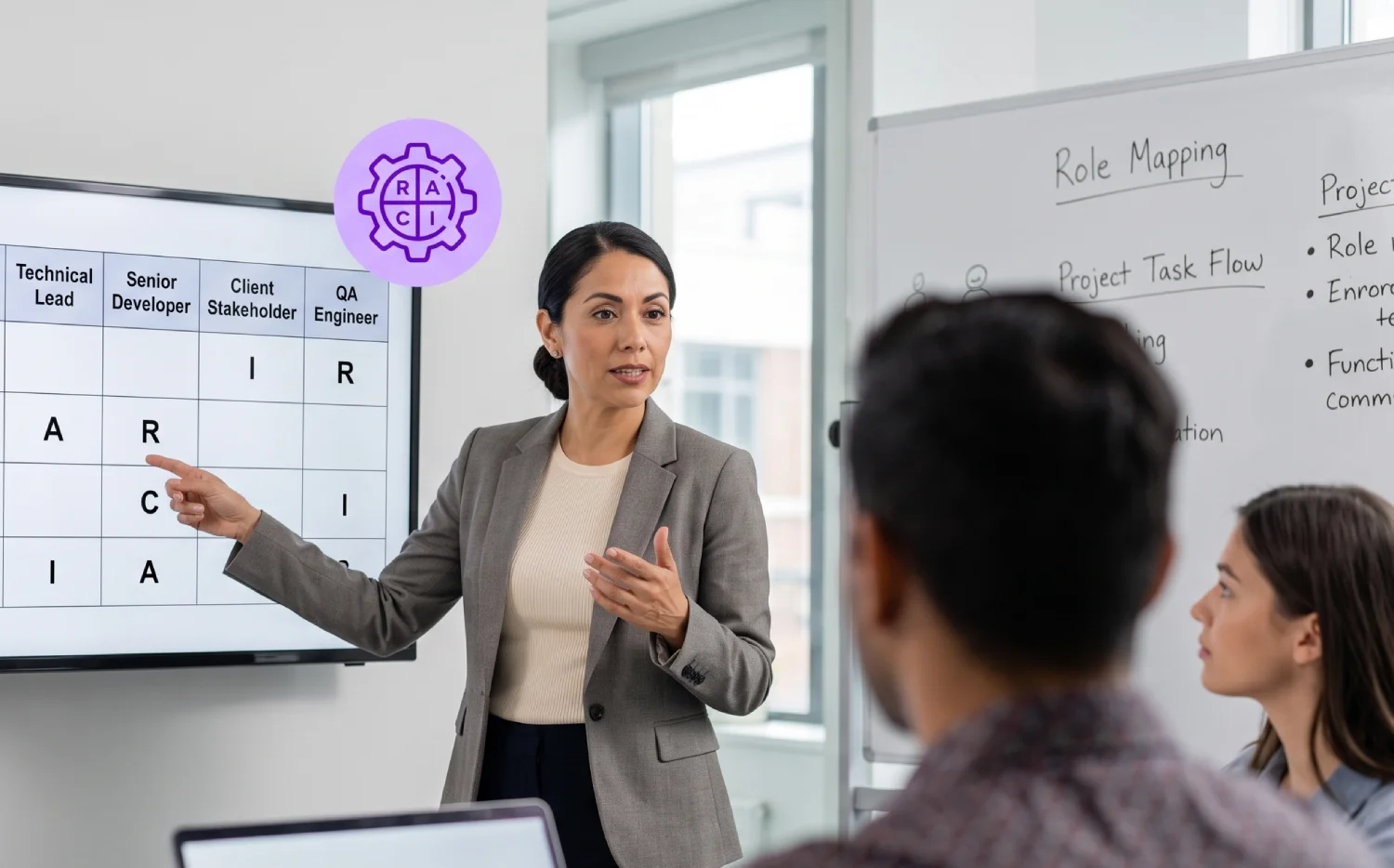
Pro Tip: Use a RACI matrix during Forming to eliminate role ambiguity before it becomes a conflict trigger in Storming. Unclear accountability is the number-one fuel for Stage 2 friction.
Stage 2: Storming The Critical Crucible
Storming is the most challenging and consequential stage in Tuckman’s model. As team members begin actual work, the initial politeness of Forming gives way to a collision of personalities, working styles, and competing priorities. People push back on authority, question decisions, and become frustrated when their individual approaches don’t align with how others operate.
This is the stage where many teams either develop real strength or never recover. Research on project failure consistently identifies unresolved team conflict as a leading contributor to cost overruns, missed deadlines, and stakeholder dissatisfaction.
Key characteristics of the Storming stage:
- Open conflict and power struggles between team members
- Resistance to authority and challenge of established processes
- Clique formation and politicking
- Frustration with workload, ambiguity, or perceived unfairness
- Decline in morale and motivation; risk of member disengagement
Leadership focus:
The project manager must shift from Director to Coach and Mediator. Avoiding or suppressing conflict is the worst possible response unaddressed conflict doesn’t disappear; it goes underground and poisons the team’s culture. Instead, create structured channels for surfacing and resolving disagreements.
Hold one-on-one conversations with each team member. Facilitate team retrospectives that separate process disagreements from personal ones. Deploy conflict resolution frameworks such as the Thomas-Kilmann model to help individuals understand their own conflict styles. Most importantly, ensure that every member’s role and contribution is visible and valued.
Critical Reality: Teams that skip Storming either because the project manager avoids conflict or because the project is too short for tension to surface often produce mediocre work. The goal is not a conflict-free team; it’s a conflict-competent team.
Stage 3: Norming Building Cohesion and Momentum
Norming begins when the team starts resolving the conflicts and power struggles of Storming. Members develop a genuine appreciation for each other’s strengths, establish agreed-upon working norms, and begin operating with greater coordination and trust. Productivity increases measurably as energy previously spent on interpersonal friction is redirected toward project goals.
The shift from Storming to Norming is often gradual and non-linear. Teams may experience short regressions particularly when a major scope change, a new team member, or a key departure disrupts established norms. The project manager’s role is to recognize these regressions early and re-stabilize rather than assume the team will self-correct.
Key characteristics of the Norming stage:
- Stronger interpersonal relationships and increased mutual respect
- Shared commitment to team goals over individual agendas
- Emergence of informal team norms and communication rituals
- Increased willingness to give and receive feedback
- Rising confidence and motivation across the team
Leadership focus:
The project manager’s role evolves from Mediator to Facilitator. Rather than actively directing every decision, the focus shifts to reinforcing the conditions that make collaboration sustainable. Document and formalize the team’s working agreements communication cadences, decision-making protocols, escalation paths.
In 2026, AI-powered project management tools are proving particularly impactful during Norming. Platforms leveraging intelligent automation can significantly reduce the administrative overhead of process standardization auto-generating status reports, flagging workflow bottlenecks, and synthesizing meeting notes into action items.
2026 Trend: Organizations using AI-assisted workflow tools report a 30–40% reduction in time spent transitioning from Storming to Norming. Automating repetitive coordination tasks removes friction from the norming process and accelerates team cohesion.
Stage 4: Performing The High-Performance Zone
Performing is the stage every project manager works to reach and the stage where the value of all previous investment becomes tangible. The team operates with minimal friction, high autonomy, and a shared commitment to excellence. Members understand their roles deeply, trust each other’s judgment, and solve complex problems without requiring constant managerial intervention.
In the Performing stage, the team is not just executing tasks it is actively problem-solving, innovating, and optimizing. Interpersonal dynamics are a source of energy rather than a drain on it.
Key characteristics of the Performing stage:
- High levels of autonomy and self-direction
- Collaborative problem-solving and shared accountability for outcomes
- Consistent, reliable delivery against project milestones
- Constructive peer feedback and continuous improvement mindset
- Strong psychological safety enabling honest, productive communication
Leadership focus:
The project manager transitions to strategic Delegator. The key risk at this stage is micromanagement a natural instinct for managers who have been closely involved in earlier stages, but deeply counterproductive to a team operating at this level. Focus your energy on removing organizational blockers, managing upward to senior stakeholders, and developing individual team members for their next roles.
Agile Connection: In Scrum and other Agile frameworks, a fully Performing team maps closely to the concept of a self-organizing team. Sprint velocity stabilizes, retrospectives generate genuinely actionable insights, and the team demonstrates consistent delivery predictability the hallmarks of Agile maturity.
Stage 5: Adjourning Closing with Intention
The Adjourning stage, added by Tuckman and Jensen in 1977, addresses the often-overlooked final chapter of every project team’s lifecycle. When the project concludes, team members experience a genuine mix of emotions pride in what they’ve accomplished, sadness about ending strong working relationships, and anxiety about what comes next.
For project managers operating within formal methodologies, the Adjourning stage maps directly to the Project Closeout process group in the PMBOK® Guide. It is not ceremonial it is operationally critical.
Key characteristics of the Adjourning stage:
- Mixed emotions: satisfaction, nostalgia, and anxiety about dissolution
- Declining engagement as team members mentally transition to their next assignment
- Risk of knowledge loss if lessons learned are not systematically captured
- Opportunity to celebrate achievements and reinforce organizational culture
Leadership focus:
The project manager’s final role is Acknowledger and Knowledge Steward. Begin transition planning well before the formal project end date. Schedule a structured Lessons Learned session that captures what worked, what didn’t, and what the organization should replicate or avoid in future projects.
Publicly celebrate the team’s achievements. Teams that feel properly recognized are significantly more likely to bring the same level of commitment to their next assignment. Document performance records, archive project deliverables, and release resources in a planned, coordinated manner.
Best Practice: For long-duration projects, consider conducting interim Lessons Learned sessions at key milestones rather than waiting until project close. This captures insights while they’re fresh and allows the team to apply learning within the same project lifecycle.
Leader Actions by Stage: Quick-Reference Guide
The table below provides a structured overview of how the project manager’s role and priorities shift across each of Tuckman’s five stages.
| Stage | Leader’s Role | Key Action |
|---|---|---|
| Forming | Director / Guide | Define mission, clarify roles, introduce Stakeholders |
| Storming | Coach / Mediator | Facilitate communication, resolve role conflicts |
| Norming | Facilitator | Reinforce trust, standardize processes, set success metrics |
| Performing | Delegator | Empower team autonomy and strategic decision-making |
| Adjourning | Acknowledger | Run Lessons Learned session, manage knowledge transition |
Tuckman’s Model in 2026: Agile, Hybrid, and AI-Augmented Teams
When Tuckman published his original model in 1965, he was studying primarily co-located groups in structured settings. In 2026, project teams operate in radically different environments geographically distributed hybrid teams, Agile squads operating in rapid sprint cycles, and cross-functional teams where membership shifts project-to-project. The model holds up remarkably well with important adaptations.
Accelerated Cycling in Agile Environments
Agile teams that operate in two-week sprint cycles may cycle through compressed versions of Forming, Storming, and Norming within a single release cycle, particularly when team composition changes between sprints. Scrum Masters and Agile Project Managers must be alert to micro-versions of each Tuckman stage and apply appropriate facilitation techniques at the ceremony level not just the team level.
Hybrid and Remote Work Dynamics
Research from Microsoft 365 Workplace Insights (2023) indicates that hybrid teams tend to experience longer Storming phases. Physical proximity creates informal communication advantages that remote members lack, generating subtle inequities in information access and relationship-building that the project manager must actively counteract.
Mitigation strategies include: deliberate virtual team-building during Forming, asynchronous communication norms that equalize participation, rotating facilitation responsibilities, and regular one-on-one check-ins that surface hidden tensions before they escalate.
AI as a Norming Accelerator
Perhaps the most significant 2026 development is the role of AI-powered tools in compressing the Norming stage. Intelligent project management platforms now offer automated workflow documentation, real-time collaboration analytics, and AI-generated process recommendations that dramatically reduce the manual overhead historically associated with establishing team norms.
Tools that automatically generate meeting summaries, track action item completion, and flag collaboration gaps allow teams to operationalize norms faster without the project manager having to manually referee every process decision. The result is a measurably shorter runway from Storming to Performing for teams that leverage these capabilities effectively.
Accelerate Your Team Leadership Skills with BePM®
Understanding Tuckman’s model is step one. Applying it under real project pressure managing a Storming team while hitting a deadline, supporting a high-performing team through organizational change, or closing a project in a way that preserves team morale and organizational knowledge requires a deeper set of competencies that only structured training can develop.
Ready to master high-performance team management?
- PMP® Certification Training Covers team development, leadership styles, and stakeholder management with Tuckman-aligned frameworks mapped to the current PMBOK® 8th Edition.
- Agile Leadership Certification Deepen your understanding of self-organizing teams, sprint-level group dynamics, and facilitation techniques for distributed Agile environments.
- Project Management Office (PMO) Frameworks Understand how enterprise PMOs standardize team development practices across project portfolios.
References & Sources
- Bruce Tuckman / Psychological Bulletin (1965). “Developmental sequence in small groups.” https://www.uwindsor.ca/ctl/sites/uwindsor.ca.ctl/files/bruce_tuckmans_stages_of_team_development.pdf
- Tuckman & Jensen / Group & Organization Studies (1977). “Stages of small-group development revisited.” https://www.researchgate.net/publication/373727215_Leading_Teams_2_Stages_of_Group_Development
- Western Governors University / Organizational Behavior (2022). “Tuckman’s Stages of Group Development.” https://www.wgu.edu/blog/tuckmans-stages-group-development2304.html
- Microsoft 365 / Workplace Insights (2023). “Applying Tuckman’s stages of group development.” https://www.microsoft.com/en-us/microsoft-365-life-hacks/organization/tuckmans-stages-of-group-development

Written by Priscilla Medina
She has more than seven years of experience leading digital transformation, technology, and strategy projects in international corporate environments. She is PMP®, ACP®, RMP®, PBA®, Scrum Master, and Coach certified, applying predictive and agile methodologies in real high-impact projects. She is currently Vice President of PMI Levante (PMI Spain) and trains professionals who seek real results, not just passing an exam.

About us
We are an international academy founded in Switzerland that trains professionals in Project Management. We accompany you on your journey towards certification and professional growth.
Follow us on social media!
Subscribe to the newsletter
You will receive news, tips, and a 10% discount coupon that you can redeem on your next purchase.

Doble títulación profesional
Scrum Master®
- From zero to hero in 6 months
- 100% online, available 24/7
- Scrum Master® Simulators
- 1:1 mentoring session
- Examination fees included